

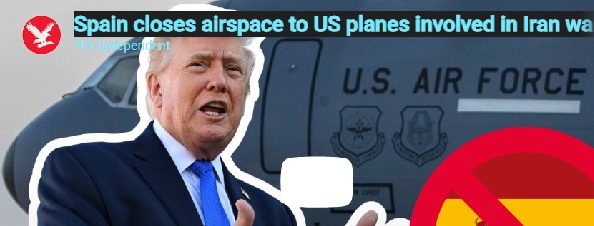
Spain and Italy refuse landing permission for US military plane on its way to war with Iran. Trump is using the incident to reinforce his “America First” line. On Truth Social, he declared that the US will no longer defend countries that do not assist the US militarily: “You have to start learning to fight for yourself.”
The president openly questioned the US security guarantees within NATO. If allies do not grant landing permission, the US is not obliged to come to their rescue in the event of an attack. In addition, he linked the military support to the oil supply in the Strait of Hormuz. The message was that if Europe does not support US efforts against Iran, they will be responsible for securing their own energy supply.
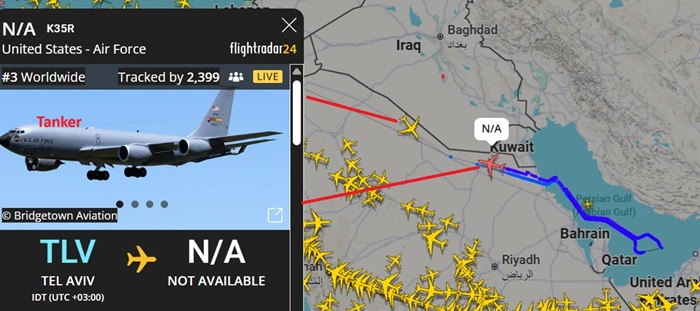
Trump specifically criticized the Spanish government for a lack of loyalty and expressed disappointment with Italy (despite previously good relations with Meloni), which he described as a betrayal of the foundations of the alliance.
Paralyze Nato?
Trump used the incident as a tool to effectively paralyze NATO politically by showing that collective defense is now conditional on direct cooperation in US operations outside Europe. Legally leaving NATO is a slow process with significant congressional resistance. But as commander-in-chief of the US military, a president can de facto defuse the alliance in an afternoon by simply declaring that US guarantees are no longer in effect. Without US credibility, NATO becomes what some analysts call a “paper tiger.”
The president can undermine the collective defense clause. NATO’s Article 5 states that an attack on one member is an attack on all, but it does not force a country to send troops. Each country decides for itself what measures it considers “necessary.” By publicly declaring that the United States will not defend allies that have not “paid for themselves,” it destroys the deterrent effect. If an aggressor believes that the United States will not intervene, NATO has effectively ceased to function as a security guarantee.
Stabbings in Europe
The US provides the backbone of NATO’s command structure and logistics. The US can unilaterally withdraw its troops from Europe, close bases (such as Ramstein in Germany), and stop sharing intelligence and satellite data. Without US logistics (air refueling, transport aircraft, reconnaissance), most European countries have very limited ability to conduct major operations.
NATO makes all its decisions by consensus, meaning everyone must agree. The US can use its veto power to block everything from budget decisions and appointments of new commanders to operational plans. This would lead to total administrative and decision-making paralysis. Especially if Trump cuts funding. Because NATO has a joint civil and military budget for the operation of headquarters and joint systems (e.g. AWACS surveillance plan).
Leave NATO?
NATO’s founding document, the Washington Treaty , has a specific withdrawal clause in Article 13. A member country can terminate its membership by sending a formal notification (”notice of denunciation”) to the US government (which is the treaty’s depositary). After the notification is sent, the country must wait one year before the withdrawal becomes formally valid./ By Ingemar Lindmark
In December 2023, the US Congress passed a law (as part of the National Defense Authorization Act ) that prohibits a president from leaving NATO without the approval of two-thirds of the Senate or a specific act of Congress. This means that a president who wants to leave NATO would legally find himself in a constitutional battle with Congress. Since Republicans only have a narrow majority in both chambers, a formal withdrawal is unlikely.
Timeline
March–April 2026
- Early March: The US and Israel launch a major military operation against Iran following an escalation in the Middle East. The EU warns early of an uncontrolled regional escalation.
- Mid-March: Spanish Prime Minister Pedro Sánchez calls the war “illegal and unjust” and announces that the joint bases of Rota and Morón may not be used for offensive operations against Iran.
- March 27: All 32 NATO countries are now reported to have reached the target of 2% of GDP in defense spending, but political rifts are deepening despite economic progress.
- March 30: Spain takes the next step and completely closes its airspace to all American aircraft (including refueling aircraft) participating in operations against Iran.
- March 31: Italy denies US bombers permission to land at Sigonella base in Sicily. Defense Minister Guido Crosetto explains that the US did not seek permission in time for the parliamentary review required by international treaties in acts of war.
- End of March: Donald Trump also accuses France of blocking overflights of military equipment to Israel, creating a sense of a united European front against the US strategy.
Summation
EU support and European response
The EU has officially expressed great concern about the military escalation. While individual countries have made decisions about their airspace, the EU as a whole has prioritized:
- Diplomatic solutions: Brussels has tried to act as a mediator to avoid the Strait of Hormuz being permanently closed.
- Enhanced maritime protection: The EU has expanded its own naval operations in the region to protect European trade, regardless of the US offensive.
- Internal division: Despite the opposition from Spain and Italy, there is a fear among other members (especially in Eastern Europe) that these blockades will cause the US to completely withdraw its support for Ukraine.
Trump’s reaction: An alliance in turmoil
President Trump’s response is desperate, even by his standards. He has used the events as leverage to renegotiate the US role in NATO:
- Conditional Defense: Trump declared on Truth Social: “You have to start learning to fight for yourself, the United States will not be there to help you anymore.” He means that if allies deny basic rights, the United States’ obligation under Article 5 ceases.
- Trade threats: He has threatened punitive tariffs and breaking trade agreements with Madrid as direct punishment for the airspace blockade.
- Criticism of “braggadocio”: Secretary of State Marco Rubio has criticized Spanish leaders for “bragging” about hindering an ally, while expecting American protection from threats in Europe.
/ By Ingemar Lindmark