

Russian oil and gas are being sanctioned. But who cares about Russian coal?
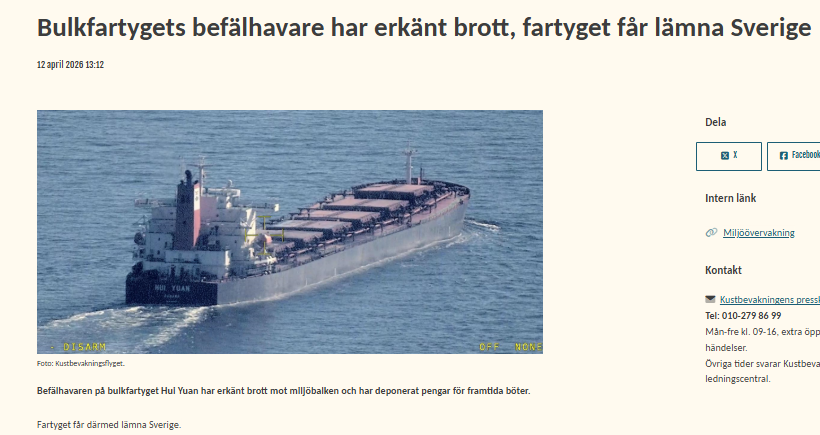
From the coast guard’s flight on April 10, the crew of the Huy Yuan saw coal residues from the decks being flushed into the Baltic Sea, in Sweden’s economic zone. Not only the Swedish Environmental Code but also the international MARPOL Convention prohibits the discharge of waste, such as coal. It must be handled in the ports, which costs money.
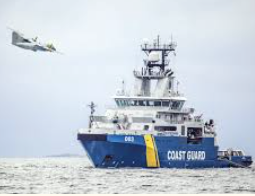
The Panama-registered ship was boarded on April 11 outside Ystad on the prosecutor’s order for a violation of the Environmental Code. The Coast Guard’s press release: ” On behalf of the Prosecutor’s Office, the ship was boarded outside Ystad at 8 a.m. on Sunday morning by the Coast Guard crew of KBV 003. A preliminary investigation has been initiated and the prosecutor has decided that an interrogation will be held. The suspicion is a violation of the Environmental Code.”
The press release does not mention false flag or stateless status. The ship is registered in Panama. Nor is there any suspicion of lack of seaworthiness – unlike previous boardings of Russian shadow ships such as Caffa or Sea Owl 1 in March 2026, where maritime law was invoked. Although the seaworthiness may still be reviewed. The worn-out Hui Yan is 22 years old, owned by a Chinese shipping company. But it is not counted as part of the shadow fleet, that is, defunct tankers with Russian oil.
Toothless law
The Baltic Sea is a so-called “Special Area” under the MARPOL Convention, which means stricter discharge regulations than in normal sea areas. In the Baltic Sea, there is an absolute ban on oil discharges from ships, regardless of quantity or circumstances. Discharges of solid waste such as coal residues are completely prohibited in special areas such as the Baltic Sea – even slippage water with residues.
The sanction according to Swedish practice is limited to fines, in some cases a hundred thousand kronor. Or staffing orders for a few thousand. So low that they hardly prevent harmful emissions. It is difficult to prosecute foreign ships.
Darkened route?
One reason for the boarding could be the ship’s strange route report, from India to Las Palmas on the Spanish island of Gran Canaria. Without information about the ship loading coal in the Russian port of Ust Luga on the Gulf of Finland. EU rules stop imports of Russian coal so what is the actual destination?
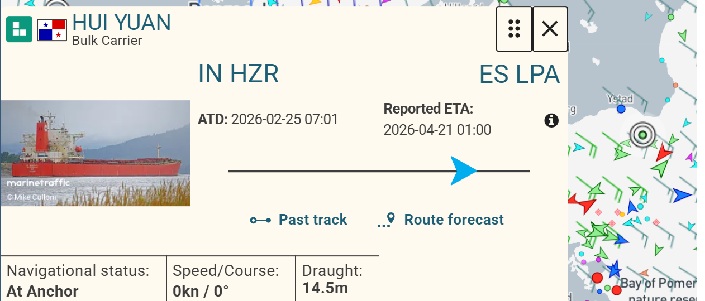
The ship left the coal quay at Ust Luga on April 9. This quay escaped drone attacks that damaged the oil facility. According to Marine Traffic, the route from India to Las Palmas began on April 21. Gran Canaria lacks steel mills and power plants that can be fired with coal. Transshipment to recipients in Africa is unlikely, as the coal cannot be brought ashore due to the EU ban on receiving Russian coal.
The ship will most likely be redirected to recipients in Asia, probably India or China, where electricity production is being switched to coal to compensate for the shortage of oil.
Situation at 3 pm on April 11
The captain receives a penalty notice of 50 daily fines of SEK 500. The ship leaves Swedish waters.
/ By Ingemar Lindmark