

Opened for Neue Ostpolitik on Swedish Flag Day. Maybe ”Helan går” made the Cold War thaw – and the Soviet Union implode.
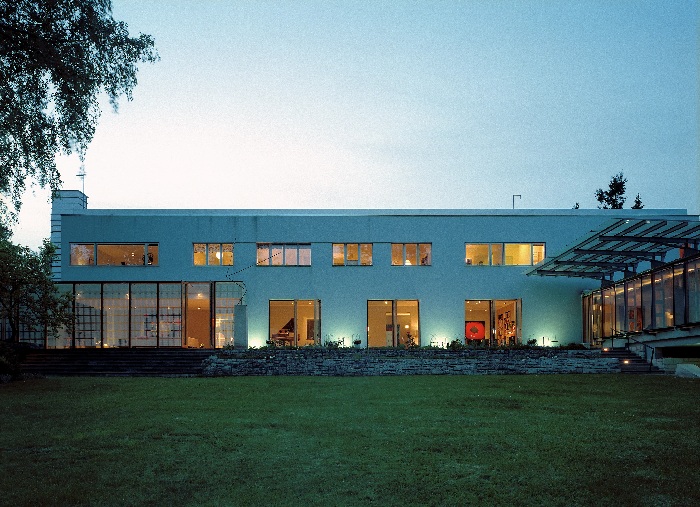
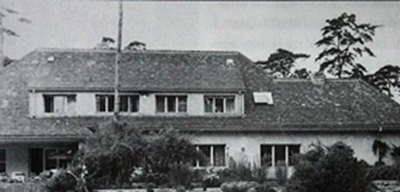
Anyone who is greeted at the home of the Swedish ambassador on Pücklerstraße in Berlin might notice a sign under house number 44. < GMap > < Map view > < Wikipedia >
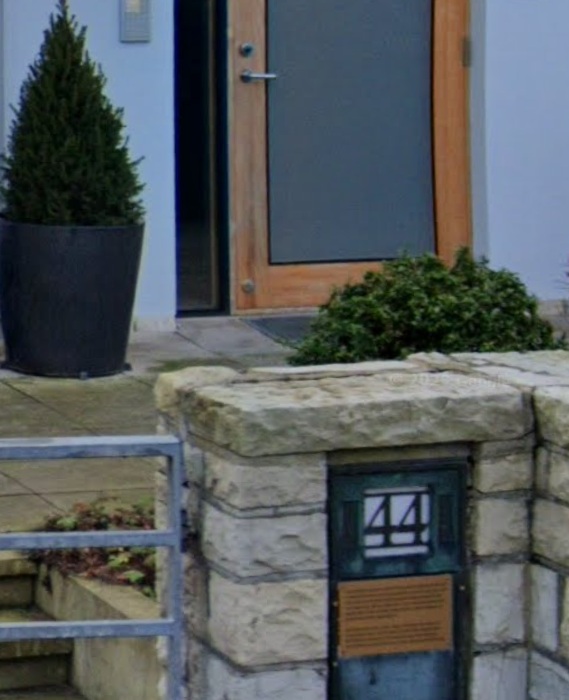
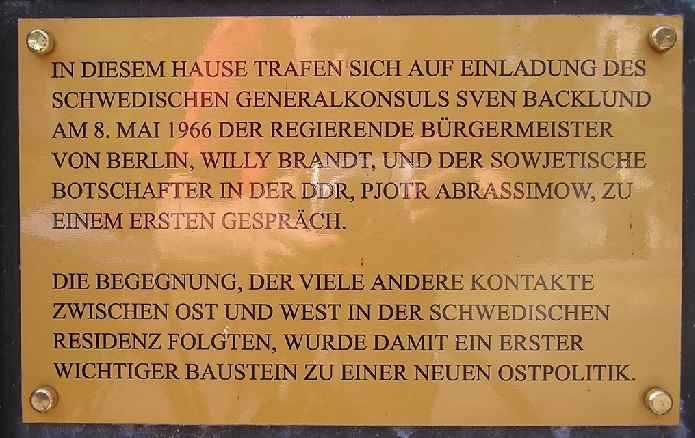
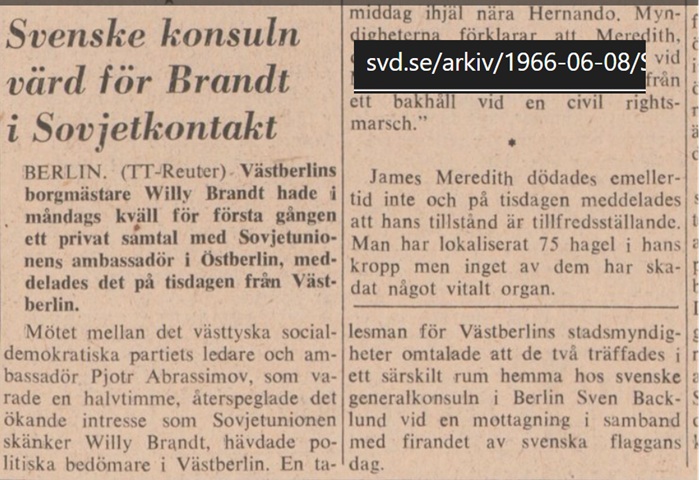
” In this house, at the invitation of the Swedish Consul General Sven Backlund , Berlin Mayor Willy Brandt and the Soviet Ambassador to the GDR, Pjotr Abrassimov , met for their first talks on May 8, 1966. This meeting, which was followed by many other contacts between East and West in the Swedish residence, thus became a first important building block for a new East German policy.”
Actually, one could have added: Nue Ostpolitik became a détente that led to the Helsinki Agreement in 1975. With Olof Palme and Willy Brandt as the inspirations for the so-called third basket on human rights. The Soviet Union could no longer sow rebellions with tanks, as in Prague in 1968. Charter 77 in Czechoslovakia, Solidarity in Poland and dissidents in the Soviet Union were given protection. Which contributed to the collapse of the Eastern Bloc.
The first handshake
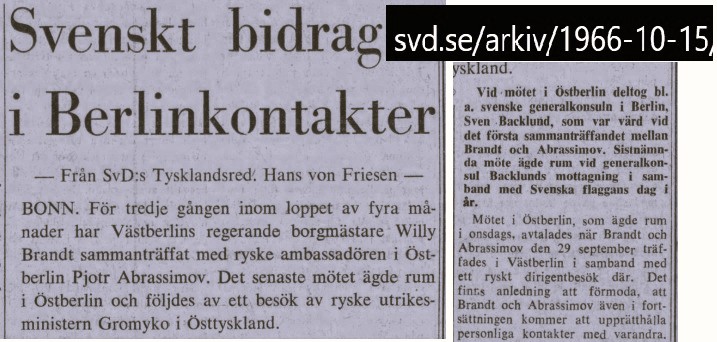
The seeds of the new Eastern policy were sown at the Swedish Consulate General on May 8, 1966. Sven Backlund , Consul General in Berlin since 1964, invited Ambassador Peter Abrassimov and Berlin Mayor Willy Brandt . Not much more than a handshake took place during this hour. But it was decided to have another meeting at the same place on Sweden’s National Day. ”When we would exchange views on the issues that had been raised,” Abrassimov said later.
Willy Brandt asked his driver to stop a short distance away. He wanted to walk the last bit to Backlund’s meeting so as not to attract attention on this Sunday morning.
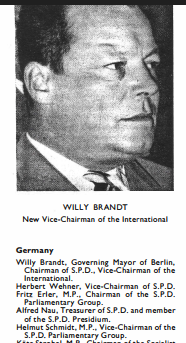
Brandt had participated as vice-chairman in the Socialist International Congress in Stockholm the previous days, with participants from some fifty countries. German SPD chairman Brandt and vice-chairman Herbert Wehner met there friends from the war years – in addition to Austria’s former foreign minister Bruno Kreisky, the host country’s foreign minister Torsten Nilsson . Party leader Tage Erlander can also be counted among the circle of friends – despite the fact that as state secretary he was responsible for Herbert Wehner, then a communist sent from the Soviet Union, being put in an internment camp .
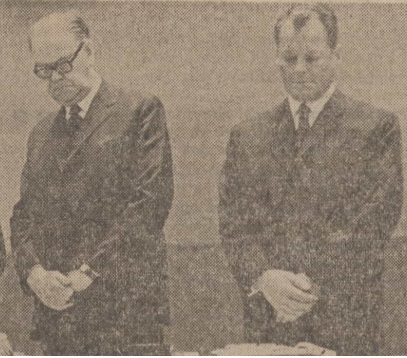
Abrasimov preferred to speak to the mayor of Berlin rather than to the conservative government in Bonn. East and West Germany did not recognize each other as states, so their representatives could not talk to each other. Old grievances from their stay in Moscow meant that former communist Herbert Wehner and GDR boss Walter Ulbricht did not like each other.
.A background
A Russian ambassador, a mayor of Berlin and a Swede on neutral ground was perfect. Brandt did not want to unnecessarily anger West German Chancellor Adenauer in Bonn. It was enough for the stubborn CDU leader to call Willy Brandt Herbert Frahm, referring to his illegitimate birth and Nordic exile during the war.
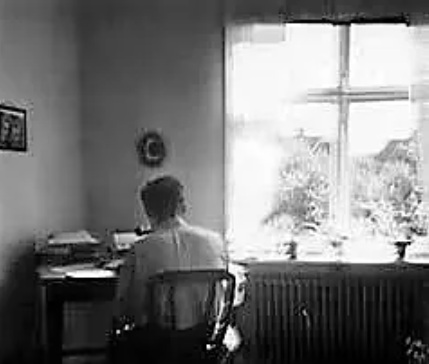
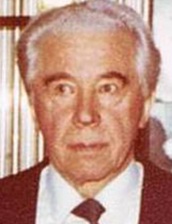
Abrasimov, as ambassador, also had a backpack. He had been a high-ranking officer in the Red Army during the war, served as secretary of the Communist Party’s Central Committee, and had a diplomatic career in Poland, among other places.
Diplomat Sven Backlund was a social democrat at heart, who chose not to pursue more prestigious assignments to become consul general in Berlin in 1964. This was under Foreign Minister Torsten Nilsson, a close friend of Brandt since the war years.
The Consul General was seen as an odd figure in the Swedish Foreign Ministry, a smart political fixer but considered outspoken and not particularly diplomatic. The fact that Backlund’s father, the editor of Ny Tid in Gothenburg, had newly translated The International into Swedish probably added spice to the Russian contact.
Swedish Flag Day

The meeting was a political sensation because it broke with the strict diplomatic protocol of the time. Brandt took a great political risk by meeting with the Soviet ambassador, especially on neutral ground in West Berlin.
The Swedish Consulate General offered the necessary discretion. Brandt could arrive without attracting attention from the press or political opponents. However, no more secret than the Stockholm newspapers could inform.
Sven Backlund described the meeting as initially tense. The dialogue aimed to circumvent the locked positions between East and West. The main purpose of the meeting was to explore the terrain for a normalization of relations. Human relief for Berliners was discussed, such as a passport agreement to be able to visit relatives on the other side of the wall.
Alcohol loosened tongues
National Day on the consulate’s terrace was celebrated with gusto, according to Egon Bahr: ”At first the atmosphere was chilled and reserved, as you might imagine. Then it became more relaxed. Firstly, because Swedes like alcohol. Secondly, because Russians also like alcohol. And thirdly, because Willy Brandt didn’t say no either. People didn’t get drunk, but there was a lot of drinking . ”
The meeting marked the beginning of a close collaboration. It was here that Brandt and his party brother Egon Bahr began to test the idea of “change through rapprochement” directly against the Russians. Egon Bahr served as the architect of Wandel durch Annäherung .
Sven Backlund’s role was crucial
He was not only a host but also acted as a courier and confidant for both sides. “The Swedes have contributed more than they are aware of,” remembers Egon Bahr. The Americans did not want to talk to GDR officials about the crisis at the wall, but turned to the Russians, who stood as guarantors of the Potsdam Agreement between the great powers at the end of the war.
The quotes are taken from interviews by Sveriges Television. There, Sven Backlund summarizes: ”There is an incredible misunderstanding between countries. Which complicates the problems completely unnecessarily. Many conflicts could have been avoided if we had made it clear to each other in time that the conflict was not that big, that it was solvable. Or how to minimize the effect of the contradictions. ”
It would not be surprising if Carl Gustaf Svingel was among the hundred or so guests on the lawn. The Opera Singer, as Brandt used to call him, was the mayor’s ear beyond the wall. Not only within the church and bureaucrats like State Secretary Hans Seigewasser. But also via lawyer Wolfgang Vogel, he had direct access to the GDR’s head of government, Ulbricht.
Abrassimov gave praise: ”At our first meetings, I want to emphasize that and the subsequent development of Soviet-German relations, we have much to thank the Swedish Consul General Sven Backlund for.”
Geography lesson
Ten minutes by car. Or three quarters to three kilometers from Brandt’s residence at Taubertstraße 19, to Backlund’s residence at Pücklerstraße 42/44. < GMap > < Map view >
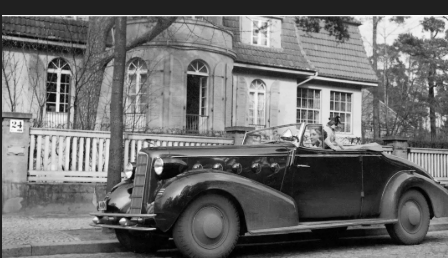
Halfway, opposite Grunvaldtparken, Brandt could have glanced at Wildpfad 24. A house owned by Jews before the Aryanization,< GMap > < Map view > < Info > Zarah Leander lived there until the house was bombed and she moved to Max-Eyth-Straße 12A, a stone’s throw from Backlund’s house on Pücklerstraße. Her house on Eyth-Straße was also burned by a bomb, which forced her to move back to Sweden in 1943. < GMap > < Map view > < Info
Brandt fled to Norway to escape the Gestapo in 1935. Then to Stockholm in 1940, chased by the Gestapo in Oslo. From Brandt’s home on Taubertstrasse it was not many steps to Hagenstraße 22 where Gestapo chief Heinrich Himmler lived during the war. < GMap > < Map view > < Photo >
House Victoria
Brandt could also take the apostle horses to Carl Gustav Svingel’s retirement home, Haus Victoria, at Winklerstrasse 5, just 10 minutes from the mayor’s residence on Taubertstrasse. The host Svingel was like a fly on the wall, guaranteed to be discreet when Brandt consulted with his SPD comrades in the house. Among them were Herbert Wehner and Helmuth Schmidt. Brandt’s advisor Egon Bahr outlined a softer Eastern policy than the CDU’s hardline Hallstein Doctrine . Consul General Backlund happened to attend these meetings.
Unlike the SPD’s party strategists, der Opersänger, as Svingel was called, was able to contribute important information from his network of contacts. He negotiated in Haus Victoria together with Herbert Wehner with the GDR lawyer Vogen about the release of prisoners from East German prisons.
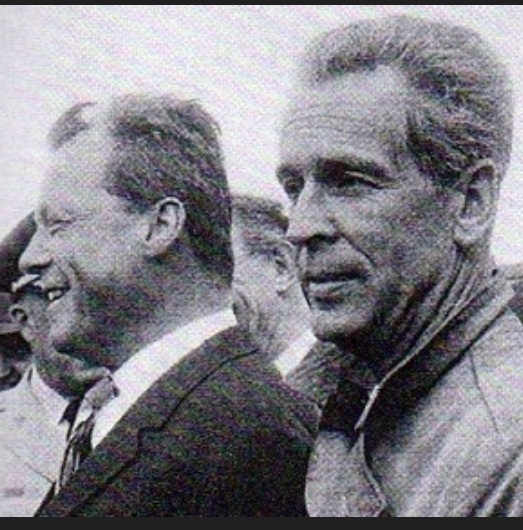
Two photos show that Svigel and Brandt were already acquainted in the early 1960s. One shows the two together when the People’s Army blocked the Brandenburg Gate with barbed wire in 1961. The other photo shows Rut Brandt meeting Svingel at Haus Victoria in the early 1960s.
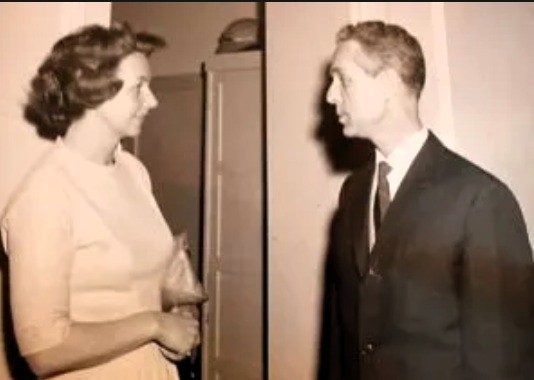
Victoria House; < GMap > <Wikipedia > < Photo>
Russian Post
In 1963, Svingel was at a crayfish dinner at the Finnish Consul General in Berlin, where Koskenkorva was probably served. The fraternization led to continued acquaintance with the Deputy Foreign Minister of the GDR and, more importantly, the Soviet Union’s new GDR ambassador, Pjotr Abrassimov. They even became friends, according to a ten-page article about Svingel in Der Spiegel.

In the picture: Colonel Stig Wennerström, Minister of Defense Sven Andersson, Minister of Foreign Affairs Östen Undén, Prime Minister Erlander and Cabinet Secretary Sverker Åström. According to defectors, Wennerström’s and Åström’s agent names were Örnen and Getingen, respectively.
Carl Gustaf Svinge proposed a prisoner exchange to the Swedish government in which the convicted spy Stig Wennerström would be exchanged for Raoul Wallenberg. The proposal came after contacts with an East German or Soviet representative. He conveyed this via Consul General Sven Backlund to Foreign Minister Torsten Nilsson on 22 February 1966.
On March 15, 1966, the matter was presented to Prime Minister Tage Erlander, Foreign Minister Torsten Nilsson and Sven Backlund. The answer was a resounding no.
Unter den Linden
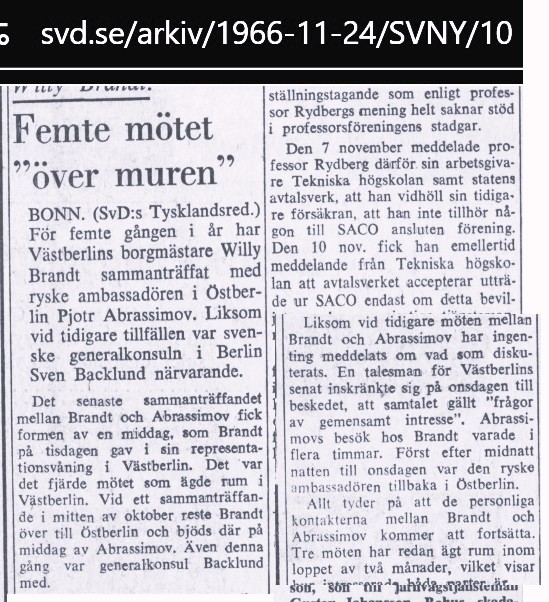
The socializing at the Consul General’s residence was followed by several meetings. In October 1966, Brandt went through Checkpoint Charlie to Abrassimov’s reception on Unter den Linden, where a concert was held. Afterwards, Brandt discussed great power politics with the host, together with Sven Backlund and Soviet representatives.
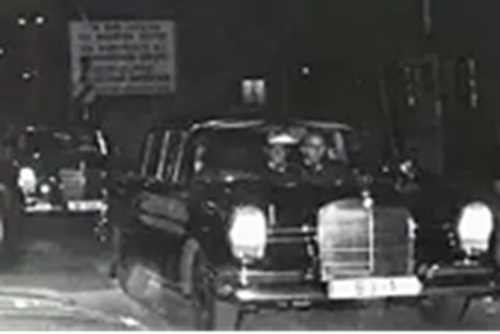
Backlund did not reveal anything about the five-hour meeting, other than that the talks would continue. The women were treated to a film in the meantime. It was the first time Brandt had visited East Berlin since the wall was built.
New Ostpolitik
In December 1966, Brandt was given a platform for the SPD’s Eastern policy when he became Foreign Minister in the coalition government under Chancellor Ludwig Erhard (CDU). Herbert Wehner was Minister for Common German Affairs until the autumn of 1969. Ostpolitik was prepared, contacts were made with the Soviet Union. But there was a clash with his coalition brother over the issue of the German-Polish border.
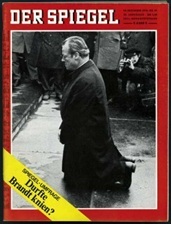
Détente became even more topical in 1969 under an SPD government with Brandt as Chancellor. Symbolized in 1970 by Brandt’s kneeling in Warsaw .
The contact with Abrassimov contributed to Herbert Wehner, who was then the group leader and ideologist for the Social Democrats in the Bundestag, wanting Svingel’s help with buying refugees. This was successful after persuasion from a representative of the Lutheran Church. Before that, Svingel’s efforts had been about helping Swedes in distress.
Olof Palme became Swedish Prime Minister in 1969 and Bruno Kreisky Austrian Chancellor in 1970. Together with Willy Brandt, the “Three Musketeers” began a close foreign policy exchange. This can be seen as a basis for a European thaw. Manifested with the third basket on human rights in the Helsinki Agreement of 1975.
Timeline
1935–1940s: Exile and background
- Brandt : Escapes to Norway (1935), then Stockholm (1940) to escape the Gestapo.
- Svingel : Builds contact networks in Berlin during the post-war period.
- Palme : Studies and early social democratic career in Sweden.
- Kreisky : Exile in Sweden under war.
- Backlund : Social Democratic background, father translates The Internationale.
1957–1964: Positioning
- Brandt : Mayor of West Berlin (1957–66).
- Svingel : Active in Haus Victoria, contacts over the wall.
- Backlund : Consul General in Berlin (from 1964) under Torsten Nilsson.
1966: Meeting in the Swedish residence
- May 5–8: Brandt and Erlander at the Socialist International Congress; Backlund invites Brandt and Abrassimov (May 8) – the first handshake.
- June 6 (Swedish National Day): Continued conversations with alcohol as an icebreaker.
1969–1970: The breakthrough of Ostpolitik
- Palme : Prime Minister (1969).
- Brandt : Foreign Minister (1966–69), Chancellor (1969).
- Kreisky : Federal Chancellor (1970).
- Svingel : Helps with refugee purchases via the church and GDR contacts.
1970–1975: “The Three Musketeers” and détente
- Brandt/Palme/Kreisky : Cooperation leads to the Helsinki Accords (1975), the third basket on human rights.
Links
Chancellor Brandt with the man at the wall – who was as silent as the wall
The August weeks when a third world war was imminent
On Sunday, August 13, 1961 , Mayor Willy Brandt had to interrupt his election campaign and board a plane to Berlin. A furious mayor saw the People’s Police roll out barbed wire around East Berlin, wire that the GDR had largely purchased from the West. The construction, which was in violation of the Great Power Agreement, came as a complete surprise. In response to Brandt’s impassioned letter, John F Kennedy sent military reinforcements and his vice president to Berlin. Continue reading “Chancellor Brandt with the man at the wall – who was as silent as the wall”
In the shadow of the 1940s. Carl-Gustaf Svingel’s Sturm und Gesang
Carl-Gustaf Svingel’s 1940s are like gluing together an Etruscan vase. Fragments of memory images, a number of press clippings. But there are shards missing, which perhaps even those closest to him did not know about. In early September 1939, Germany attacks Poland, followed by a declaration of war from Great Britain and France. At the same time, the Soviet Union invades Poland and World War II is a fact. Why was Carl-Gustaf Svingel then in Juan-les-Pins on the Riviera … Continue readingIn the shadow of the 1940s. Carl-Gustaf Svingel’s Sturm und Gesang
KGB spy Heinz Felfe: Big politics poker game in CG Svingels Haus Victoria
December 6, 1967 Haus Victoria. Carl-Gustaf Svingel and Herbert Wehner with their stepdaughter Greta Burmester wait for three hours for the GDR’s refugee negotiator, lawyer Wolfgang Vogel. Instead, they receive a telegram saying ”the meeting for our conversation has not been approved”. Now it was serious. The KGB and Stasi want to block the prisoner purchases from the East if they do not release the master spy Heinz Felfe from the West German prison. At the meeting on November 2 at Haus Victoria, lawyer Vogel … Continue readingKGB spy Heinz Felfe: The big political poker game in CG Svingel’s Haus Victoria
Carl Gustaf Svingel. A small hunchback who overthrew a great power?
Is it possible to untangle a thread between Svingel and the collapse of the Eastern Bloc? A very simple explanation: he lived in an environment that works well in the story of the thirty-year Cold War. Svingel was certainly an important source of knowledge for Brandt and Wehner. He moved like a fish in water at official receptions. His church contacts gave him insights into the depths of the people behind the wall. Svingel was a … Continue readingCarl Gustaf Svingel. A small hunchback who overthrew a great power?
Historic wingbeats when Ingrid, Adelgard and Heidi met Carl Gustaf Svingels Hjärtum three spring days in 2019
For TV reporter Ingrid Thörnqvist, it was like opening a new page in the history book. In Hjärtum, she met people with memories from Svingel’s time in Hjärtum. From the years at the orphanage to the years he filled the church with concerts. This happened the weekend before Easter in April 2019 – as a thirty-year anniversary of the fall of the wall. Continue reading “Historical wingspan when Ingrid, Adelgard and Heidi met Carl Gustaf Svingel’s Hjärtum three spring days in 2019”
Two of the Cold War’s most notable Swedes came from the same farm in Hjärtum
The former maid Alma Samuelsson, registered in Utby Mellangård in Hjärtum parish, has a son, Carl Gustaf, on March 31, 1916. He is registered as illegitimate in the same way as his sister Anni sixteen years earlier. Alma was born in 1877 under Utby Norgård, as the daughter of the laborer Samuel Johansson and Anna Maria Johansdotter. Continue reading “Two of the most notable Swedes of the Cold War came from the same farm in Hjärtum”
”Ambassador” Svingel opens holes for politicians in the Iron Curtain
” …in August 1966, Erlander took the ferry to Öland and went up to Runsten to visit his friend Herbert Wehner at his summer cottage there. ” So writes Östra Småland. Continue reading ””Ambassador” Svingel opens holes for politicians in the Iron Curtain”
Carl Gustaf Svingel, one of the great Swedish lifeguards of the 20th century
Raoul Wallenberg saved the lives of several thousand Jews in Budapest during World War II. Folke Bernadotte transported 15,000 from the concentration camps in the white buses. Continue reading
/ By Ingemar Lindmark