

The region is Russia’s most critical military area
As of this writing, March 10, 2026, the NATO exercise Cold Response is underway on the North Calotte. 25 thousand troops from 14 countries trained in winter combat. Troops are being transferred from Northern Norway to Sweden and Finland. The map from https://www.notammap.org/ shows the Norwegian exercise area weeks in March, the risk area of Narvik/Troms covered a large part of the Norwegian Sea.
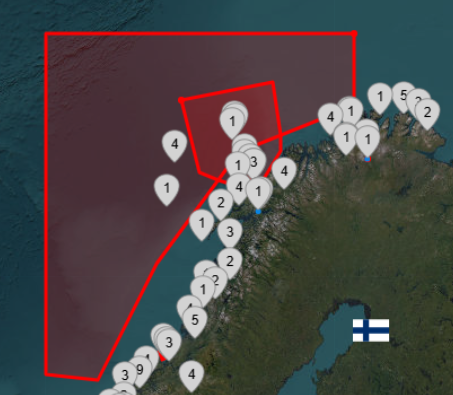
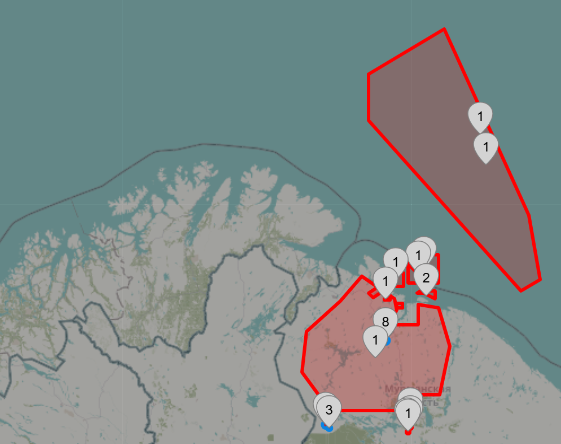
At the same time, russian exercises are underway on a large part of the Kola Peninsula, along the Norwegian/Finnish border and along the coast towards Murmansk. The map warns of the Northern Fleet’s missile firing in the Barents Sea, north of Norway’s maritime border.
On March 9, NATO and allied forces began a major military exercise in northern Finland, Norway and Sweden. Exercise Cold Response 26 brings together approximately 25,000 troops from 14 countries to train to defend NATO’s northern flank in winter conditions. As part of the exercise scenario, troops are being moved from northern Norway to both Sweden and Finland.
A showdown not only between naval vessels but also when the F-35 meets the SU-35 and Tupolev bombers over the Barents Sea.
Russian Northern Fleet, a background
- Nuclear deterrence (Bastion strategy): The strategic submarines carrying Russia’s secondary strike capability are based here. The aim is to create a ”protected bastion” in the Barents Sea where they can operate under the protection of surface forces and aircraft.
- Northeast Passage (NSR): Murmansk is the gateway to the Arctic sea route. As the ice melts, control of this route becomes both an economic and security priority for the Kremlin.
- Proximity to NATO: After Finland and Sweden’s entry into NATO, the bases in the Petjenga area (only about 10-20 kilometers from the Norwegian border) have come into direct focus as a ”front line”.
Russia is investing heavily in infrastructure until 2030–2035 despite economic sanctions:
- New submarines: Three more Borei-A submarines are planned to join the Northern Fleet in the coming years.
- Robotization & drones: Major investment in autonomous underwater vehicles (UUVs) like Sarma to patrol the Northeast Passage without human presence in extreme environments.
- Civil-Military fusion: Murmansk is being expanded as a hub for floating nuclear power plants (Rosatom) and LNG exports, which requires increased military protection.
A large portion of the ground troops from the Petjenga area have been deployed to the war in Ukraine, which has temporarily reduced conventional capabilities at the border, but the nuclear and maritime presence remains intact and prioritized.
Down Orientation Key units/Staffing Severomorsk Main Base & Flight Northern Fleet command, large surface ships (cruisers, destroyers). Gadzhi’s Strategic submarines Home of the modern Borei and Delta IV classes. Vidyajevo Attack submarines Base for nuclear submarines of older and newer designs. Zaozyorsk Attack submarines Houses the powerful Yasen -class cruise missile submarines. Petjenga/Monastery Ground forces Here are the 200th Motorized Rifle Brigade and the 61st Marine Infantry Brigade .
Here we are making a journey from the Norwegian border to Murmansk. Youtube.
Zaozyorsk (Ara Bay)
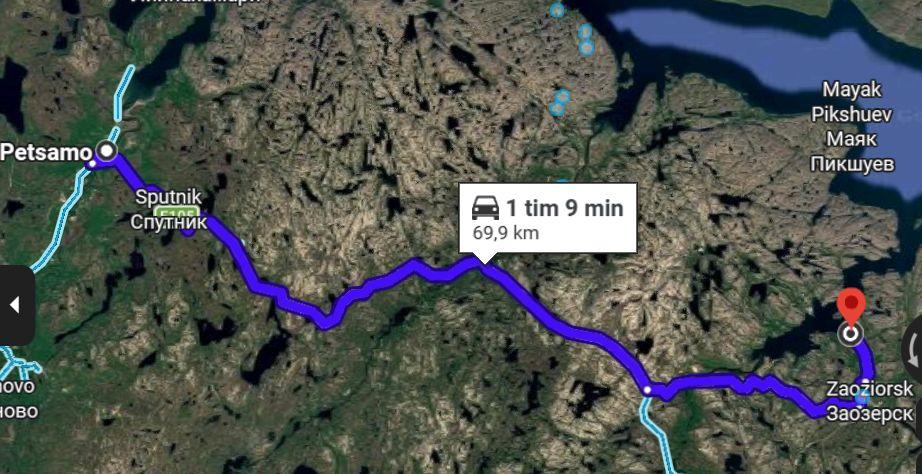
After an hour’s drive east from Murmansk on the E105, you take the exit to Litsafjorden and Zapadnaya Litsa, near the closed city of Zaozyorsk < Wikipedia > It is 120 kilometers to Murmansk and four to the Norwegian border. < Wikipediai > < GMaps > Four facilities: Malaya Lopatka, Andreyeva Bay , Bolshaya Lopatka and Nerpichya. The military fears radioactivity from spent fuel in Andreyeva Bay .
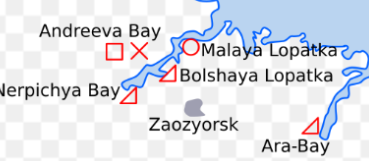
Is Russia’s largest submarine complex. It is home to Nerpichya < Map photo >, a long-standing base for strategic nuclear submarines. Attack submarines dock at Bolshaya Lopatka < Map photo > and storage facilities are located at Malaya Lopatka .
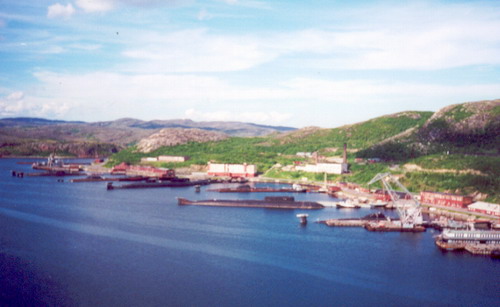
Ara Bay is one of the two fjords that make up the Vidyayevo base < Wikipedia >. While the neighboring Ura Bay is often used for logistics and smaller vessels, Ara Bay is the primary location for the Russian Northern Fleet’s 7th Submarine Division.
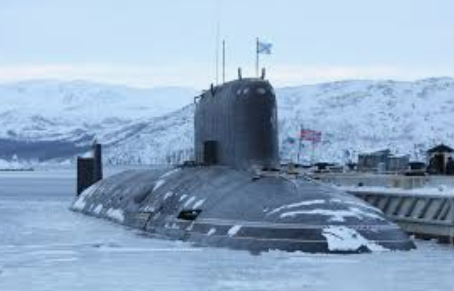
The fact that the most modern ships are stationed here is due to the proximity to the open sea in order to quickly reach the Atlantic. In 2026, approximately 8-9 nuclear submarines of the Yasen and Yasen-M type will be stationed. They are armed with the Kalibr/Oniks cruise missiles and the hypersonic Tsirkon.
Vidyaevo
Here are Russia’s older submarines and special vessels. But in the same way as Zapadnaya Litsa, they are being upgraded due to the security situation in the Arctic. < Bellona > < GMaps > > Map photo > < Route >
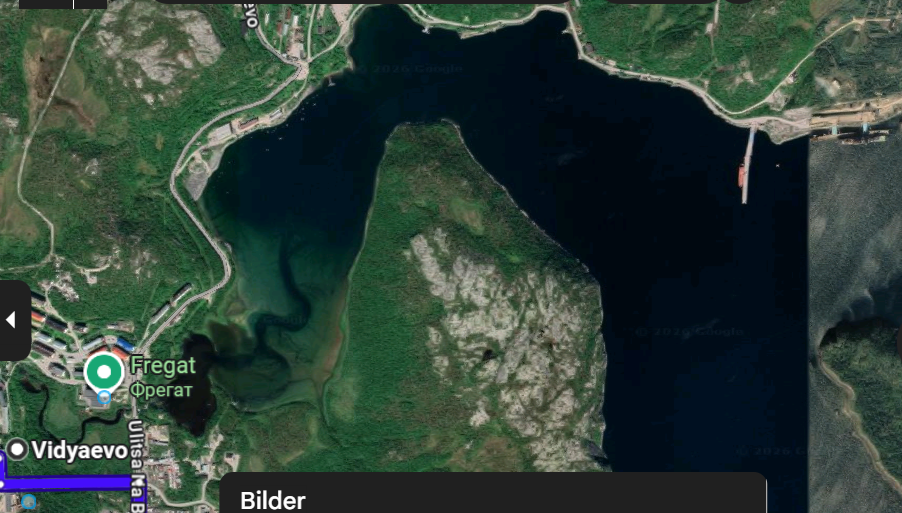
6-8 nuclear-powered submarines are located here, mainly Sierra II-class . Often 2-3 Oscar II-class missile submarines. The submarine K-141 Kursk that sank in the Barents Sea departed from here.
| Down | Primary focus | Technology level |
| Vidyayevo | Spearhead (Yasen-M) | State-of-the-art / Offensive |
| Vidyayevo | Workhorses & Special Hulls (Sierra) | Robust / Defensive & Hunting |
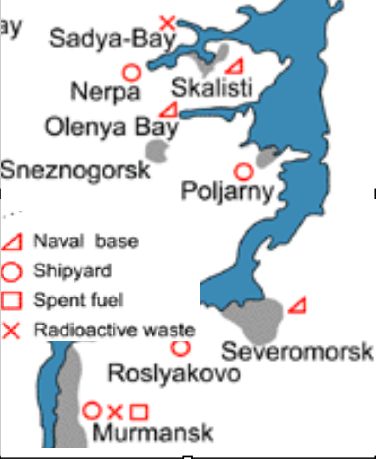
At the mouth of the Murmansk Fjord
A sixty-mile and an hour drive from Murmansk brings you to a submarine cluster at the Olenya and Sadya bays. The three bases are Gadzhiyevo, Olenya, along with the Nerpa shipyard in Sneznogorsk.
If you are allowed to come here, the resorts are closed to civilian visitors.
- Olenya Guba is the base for Russia’s most secret ”spy submarines”
- Gadzhijeo is the Russian Northern Fleet’s main base for strategic nuclear submarines , while Saida Guba is the world’s largest storage site for spent reactor sections. Olenya is also home to the Nerpa shipyard for the maintenance of nuclear submarines.
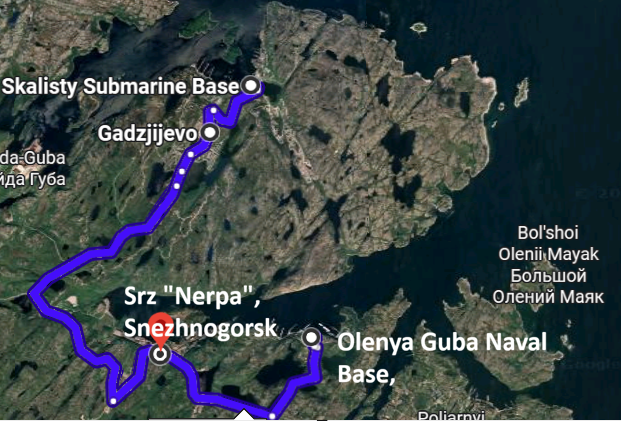
Gadzjijeo
Gadzhijevo is the Russian Northern Fleet’s main base for strategic nuclear submarines . Is a closed city for civilian visitors. The base is home to two heavy divisions with a total of 12-14 nuclear submarines : In the mountains around Gadzhijevo there are warehouses for nuclear warheads and maintenance of the Bulava and Sineva missile systems . < Wikipedia > < Gmaps > < Map photo >
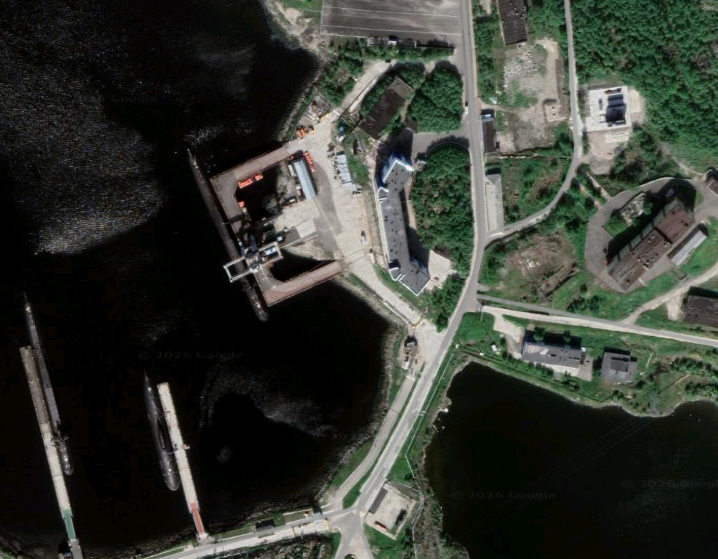
The Gadzhijevo submarines operate primarily in the Barents Sea and under the Arctic ice. The idea is to locate them in a protected “bastion” where the Russian navy and air force can defend them while they are ready to fire their missiles. < Barents Observer >
| Class | Antal (as) | Roll | Arming |
| Borei / Borei-A | 3-4 | Strategic deterrence | 16x Bulava (SLBM) |
| Delta IV | 5-6 | Strategic deterrence | 16x Sineva/Liner (SLBM) |
| Chapter I/II | 3-4 | Submarine Hunting / Attack | Torpedoes & Kalibr robots |
Olenya Guba
Located near Polyarnyj, this base is known for housing special submarines under the command of GUGI (Main Directorate for Deep-Sea Research). These units are often used for special operations and research at great depths.
< Wikipedia > < Wikipedia > < Barents Observer > < GMap > < Rutt > < Kartfoto >
Olenya Guba is one of the most closed and strategically sensitive places on the entire Kola Peninsula. Unlike the neighboring bases in Gadzhiyevo or Severomorsk, which house the pride of the conventional fleet, Olenya Guba is home to Russia’s ”secret fleet” – a special unit for deep-sea research and underwater espionage.
The base is effectively controlled by GUGI ( Glavnoye Upravlenie Glubokovodnikh Issledovanii ), the Russian Ministry of Defense’s main department for deep-sea research. GUGI reports directly to the General Staff rather than the regular naval command.
- Mission: Their official role is “research,” but the operational reality is seabed warfare . This includes installing interception systems, maintaining Russian sensors, and—most critically for the West—the ability to cut or intercept undersea fiber-optic cables.
Olenya Guba is the home port of the 29th Special Submarine Division .
- Mother submarines: Huge, converted nuclear submarines (e.g. BS-64 Podmoskovye and the gigantic Belgorod ) that act as mother ships. They carry smaller spy submarines docked beneath the hull.
- AS-31 “Losharik”: The most notorious spy submarine, known for its hull of interconnected titanium spheres that allows diving depths of up to 6,000 meters . After the catastrophic fire in 2019, it has undergone extensive repairs and is expected to return to operational service in 2025/2026.
- Haltus and X-Ray class: Smaller nuclear-powered special submarines for work at great depths.
- Yantar: The well-known ”research vessel” (spy ship) that is often sighted near international internet cables in the Atlantic Ocean often departs from here.
Expansion (2025-2026)
- Enhanced defenses: Satellite imagery from recent years shows that Russia has installed new physical barriers and floating booms at the entrance to Olenya Guba, believed to be a direct response to the increased threat from Ukrainian (and potentially Western) underwater drones.
- Marine Mammal Program: The base is known for its enclosures of trained beluga whales (remember “Hvaldimir” in Norway?). These are used to patrol the base and detect intruders or divers.
- Modernization of the port: The capacity to receive the new, longer Belgorod -class submarines has been expanded. Belgorod is a carrier of submarine-launched spy craft and the nuclear-powered Poseidon torpedo .
- Vulnerability: In June 2025, a massive Ukrainian drone attack was reported on the nearby Olenya air base (where the bombers are located). Although the Olenya Guba naval base is more protected, the security level in the entire area has been raised to maximum.
Polyarnyj
Polyarnyj is located at the entrance to the Kola Bay and is one of the oldest naval bases in the area. It is used primarily for diesel-electric submarines and smaller surface ships. It also houses significant shipyards for fleet maintenance. < Wikipedia > < GMap > < Route > < Map photo >
The film The Hunt for Red October had the fictional submarine based out of Polyarnyj.
Murmansk Naval Shipyard
Naval Shipyard 35 (35-yj Sudoremontnyj Zavod), is the Northern Fleet’s main shipyard for the repair and maintenance of large surface ships. The shipyard is known for the unsuccessful construction of the aircraft carrier project Admiral Kuznetsov . < Wikipedia > < GMap > < Map photo >
The shipyard has undergone a massive (but delayed) rebuild to fill the void created when the giant floating dock PD-50 sank in 2018. : Originally built in Gothenburg, nicknamed Trasdockan by local humor.
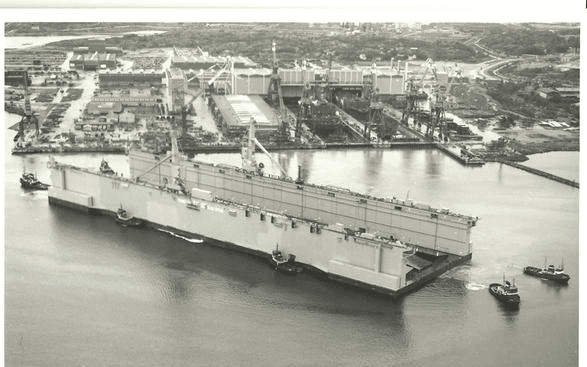
By merging two older, smaller dry docks, the shipyard has created one of Russia’s largest docking facilities. It is approximately 335 meters long and wide enough to accommodate both aircraft carriers and the largest nuclear-powered cruisers ( Kirov class). The shipyard focuses on hull repairs, engine replacements and modernization of weapons systems for large surface ships. Unlike Sevmash in Severodvinsk, which builds new ships, Shipyard 35 is primarily a repair yard .
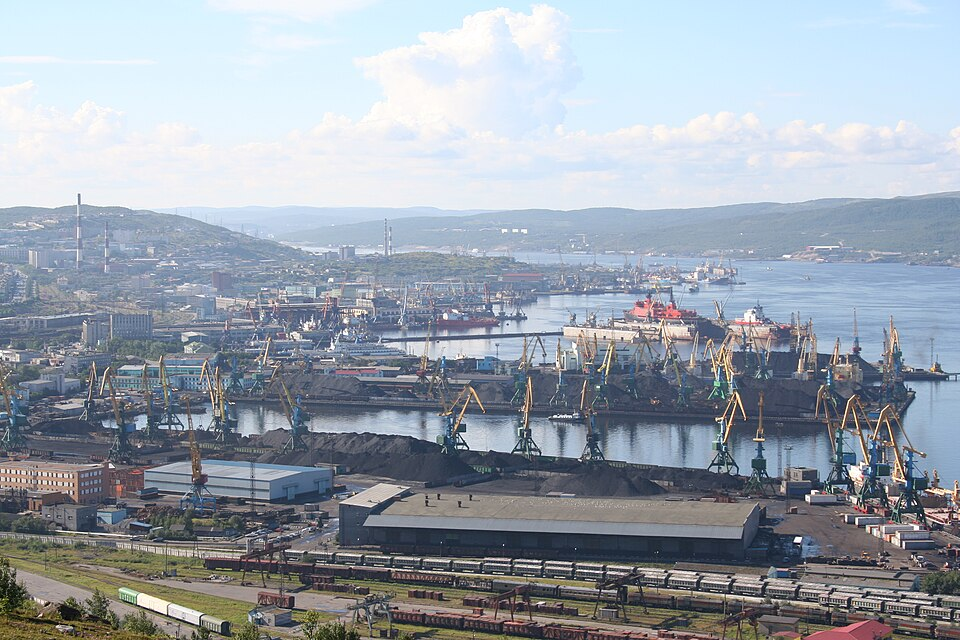
Severomorsk
Severomorsk is the administrative and operational heart of the Russian Northern Fleet . The city is a so-called “closed city” and is the base for Russia’s most powerful surface combatant ships. Severomorsk’s strategic role has been strengthened in recent years, driven by increased tension in the Arctic and NATO expansion. It is adjacent to Air Bases 1 and 3.
Strategic task:
- Strategic Deterrence: Protect the nuclear submarine bastions in the Barents Sea and ensure Russia’s ”second strike” capability.
- Arctic control: Monitor and control the Northern Sea Route (NSR), which is seen as a critical economic and military route.
- Power projection: Act as a base for long-range missions to the Atlantic, the Mediterranean and recently also escort missions for civil shipping on risky routes.
- Command Center: This is where the Northern Fleet’s staff is located, which coordinates both naval units, air forces and coastal defense units.
< Wikipedia > < GMap > < Rutt > < Map photo >
Severomorsk mainly houses the Northern Fleet’s surface combatants . Most strategic submarines are based in nearby bases, most notably Gadzhiyevo and Vidyayevo. <Wikipedia> <GMap> <Route> < Map photo >
| Category | Example of ship / Status |
| Aircraft carrier | Admiral Kuznetsov (Still under repair/modernization at shipyards in Murmansk. |
| Battlecruiser | Admiral Nakhimov (Undergoing sea trials in 2025/26 after extensive modernization). Pyotr Velikiy (Reported to be inactive/in reserve). |
| Destroyers & Cruisers | Marshal Ustinov (Slava-class), as well as several Udaloj -class destroyers (e.g. Severomorsk and Vice-Admiral Kulakov ). |
| Modern Frigates | Admiral Gorshkov class. These are the spearheads of the base, armed with Zircon missiles. |
| Submarines | Severomorsk serves as a depot and command center, but the nuclear submarines (Borei and Yasen class) operate primarily from the deep-sea ports nearby. |
Staffing: The total military presence in the Severomorsk area is unknown. The total strength of the Northern Fleet is given in Pentagon/FAS references as around 50,000 active military personnel , including sailors, marines, naval aviation and support personnel. This includes personnel belonging to a variety of units based around the Kola Peninsula and in the Severomorsk area. Despite economic challenges and sanctions, expansion has continued:
- Missile infrastructure: New storage and maintenance facilities have been built specifically to handle the new Zircon hypersonic missiles and Kalibr cruise missiles.
- Energy security: After incidents of power outages (including in early 2026 due to pylon collapses), significant investments have been made in autonomous energy supply to enable the base to operate completely independently of the civilian grid.
- Arctic icebreakers: In 2025–2026, the Northern Fleet has begun receiving more armed icebreakers (Project 23550) that can operate directly from bases on the Kola Peninsula.znetsov”
The Russian nuclear submarine Kursk departed the port of Severomorsk on August 10, 2000, for the Barents Sea 2000 exercise. The submarine sank on August 12 after a torpedo explosion.
/ By Ingemar Lindmark