

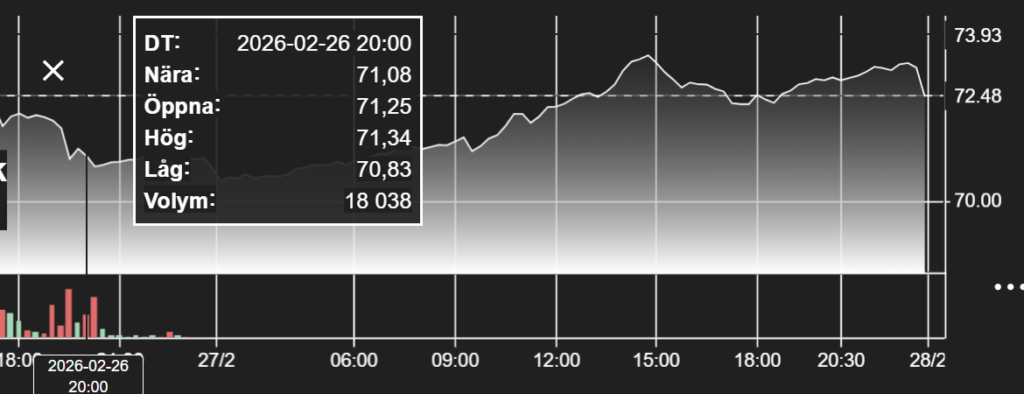
The situation surrounding the price of crude oil (Brent) is extremely volatile at the time of writing following the US and Israeli military operations against Iran over the weekend.
Brent crude closed at $72.87 on Friday , its highest level in seven months. Following the news of the bombings and threats to the Strait of Hormuz, indications are that the price could surge by 10-12% directly at Monday’s open.
Blockade in the Strait of Hormuz?
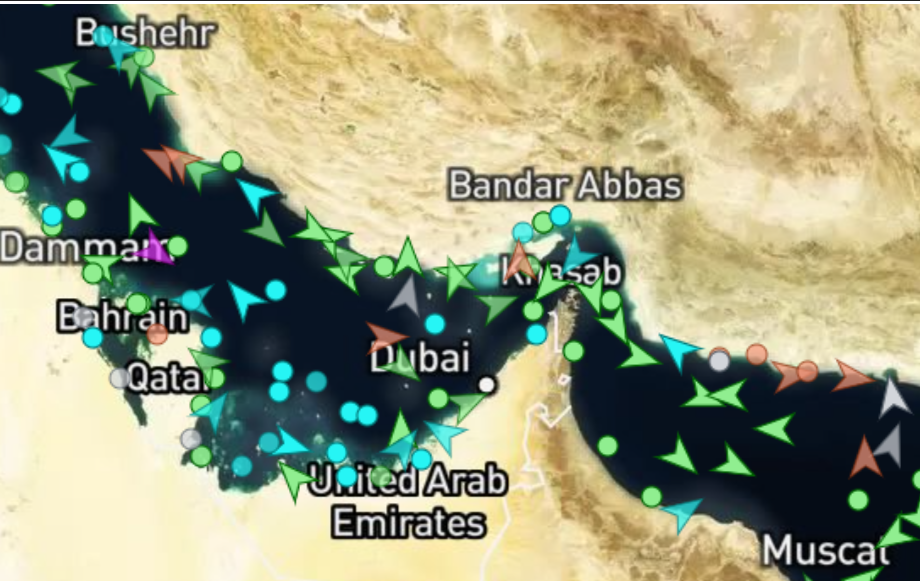
The Strait of Hormuz is the world’s ”bottleneck” through which approximately 20% of the world’s oil consumption passes.
Risk levels:
- Limited impact ($80–85): If the conflict stops at targeted operations against military targets and shipping continues (possibly with military escort).
- Severe disruptions ($90–100): If concerns about attacks on tankers increase and insurance premiums skyrocket, causing shipping companies to pause shipments. Several major players (see $100 as a highly realistic scenario for Brent under these conditions.
- Complete blockade ($120–150): If Iran manages to implement an effective blockade, even for a shorter period of time (1–2 days), analysts warn of price shocks of up to $150 . However, this is seen as a “doomsday scenario” as it would also strangle Iran’s own economy.
Critical points:
- OPEC+’s actions: An extraordinary meeting may be called to discuss whether Saudi Arabia and the United Arab Emirates should increase their production to calm the market.
- US Strategic Petroleum Reserves: President Trump may open the Strategic Petroleum Reserves (SPR) to counter price increases at the pump.
- Iran’s response: The market is waiting for confirmation whether the blockade of the strait is total or only affects certain types of ships.
There is uncertainty about how long Iran can block the Strait of Hormuz. The country has large stockpiles of mines and short-range missiles. The risk alone, increased security and the detour around Africa could affect the price. On the other hand, the Western Navy can protect itself and has the resources to clear the shipping lanes.
| Source | Estimated price (Brent) | Terms |
| Barclays | ~$100 | Continued uncertainty and supply threats |
| Capital Economics | ~$80 | If the conflict remains limited |
| Kpler Ltd | $120 – $150 | At actual stop in the Strait of Hormuz |
| Oxford Economics | ~$84 | In case of short-term disturbances |
The world economy
Short term:
In the short term (0–6 months), the effects are mainly driven by uncertainty and direct cost increases:
- New wave of inflation: After a period in 2025 where inflation began to level off, more expensive fuel and freight now threaten to push consumer prices up again. This will affect food prices, as agriculture is dependent on diesel and artificial fertilizers.
- Stagflation risk: The global economy is at risk of falling into “stagflation” – a combination of stagnant growth and high inflation. Central banks are forced to raise interest rates to combat oil-fueled inflation, while households cut back on consumption due to high gasoline prices, causing growth to slow sharply.
- Financial market uncertainty: Stock markets react negatively to rapid oil price increases (except in the energy sector). Investors flee to gold and US Treasuries, which can create liquidity problems in emerging markets.
- Logistics shutdown: The threat to the Strait of Hormuz is driving up shipping insurance premiums, as is liquefied natural gas (LNG), and making container traffic more expensive, resulting in bottlenecks in global supply chains.
Long term:
If prices remain high (over 12 months), the world economy will be forced to make deeper adjustments:
- Accelerated energy transition: Historically, high oil prices are the single strongest catalyst for renewable energy. More expensive fossil fuels make investments in electric cars, heat pumps and green hydrogen more economically attractive, which could accelerate the phase-out of oil dependence.
- Geopolitical power shift: A prolonged period of high prices benefits exporters such as the US (shale oil), Saudi Arabia and Russia, while energy-importing regions such as the EU, India and China see a massive transfer of wealth out of their economies.
- Changing production patterns: Companies may be forced to move production closer to the end market (“near-shoring”) to reduce transportation costs, further fueling the trend towards deglobalization.
- Investment boom in new fields: Prices above USD 90–100 make previously unprofitable projects (e.g. deep-sea drilling or new shale discoveries) profitable again, which in the long term could lead to a new supply shock that pushes prices down again – the classic “commodity cycle”.
| Area | Short term (Now – 6 months) | Long term (1 – 3 years) |
| Inflation | Rapid rise (energy & food) | Risk of wage-price spiral |
| Growth (GDP) | Slowdown, risk of recession | Structural transformation of industry |
| Interest rates | Paused decreases or new increases | Higher “neutral” interest rate level |
| Energy | Panic measures (open reserves) | Heavy investments in green alternatives |
Putin’s rescue?
For Russia, rising oil prices serve as a critical lifeline, especially now in early 2026 when the country’s economy is showing clear signs of stagnation and depleted reserves.
Since the Russian state budget for 2026 is based on a relatively low oil price (around $59–60 per barrel for Urals oil), the current price pressure directly strengthens the Kremlin’s room for maneuver.
Oil and gas still account for around 20–25% of Russia’s total budget revenues. A rise in the price of Brent oil will drag down the price of Russian Urals oil (despite sanctions discounts). Every dollar the price rises above the budgeted target reduces the expected budget deficit, which was forecast to be around 1.6% of GDP by 2026. This gives the government room to continue prioritizing military spending over social investments.
Russia’s liquid reserves in the National Welfare Fund have shrunk sharply in recent years to cover budget gaps.
- During the beginning of 2026, the reserve has been at a critical level (approximately 1.9% of GDP ).
- Higher oil prices mean that the state can stop drawing down reserves and, in the best case, start replenishing them, which reduces the risk of a systemic crisis at the end of the year.
When oil prices rise, the ruble usually strengthens. This is a double-edged sword for the Kremlin:
- Advantage: A stronger ruble can dampen imported inflation, which is welcome as the central bank has been forced to keep the key interest rate extremely high (around 15–16% ) to cool down the economy.
- Disadvantage: The state receives fewer rubles for every dollar/yuan sold in export revenue, which can actually make it harder to pay domestic wages and pensions if the ruble strengthens too much.
/ By Ingemar Lindmark