

Operation Spiderweb , which targeted five air bases, has been called Russia’s Pearl Harbor. 41 Russian aircraft were knocked out as a result of the attack, including A-50, Tu-95 , Tu-22M3 and Tu-160 .
google4bea300b7401f472.htmlIt is the morning of June 1, 2025 on the E105 highway towards Murmansk. Oleksandr Zaitsev receives an order on his mobile phone to take a break at a Roseneft station just south of the city of Olenegorsk. .< GMaps > < Streetview > < Route > He knows that the two containers contain wooden sheds. But not that there are maple compartments under the remote-controlled roofs.
The roofs open and 25 drones sniff over the forest a little over half a mile to the Oleneya air base. Where a large number of Tupolev bombers are parked. At a safe distance from Ukraine, it is believed, despite a drone attack in the summer of 2024. The onadrones (wasps) load three kilograms of explosives and have a quarter of an hour to attack the target, detected autonomously thanks to AI and sensors.
It’s Sunday in the middle of the day, maybe after a few vodka shots because it’s Transport Flight Day. Suddenly, explosions are heard and the plane is on fire. https://maps.app.goo.gl/mVAboJ7ciDQ4JD5s5 Destroyed planes:
- 4 Tu-95MS (Bear-H): Strategic bombers used to launch cruise missiles. Satellite imagery has confirmed that at least four of these were completely destroyed.
- 1 An-12 : A military transport aircraft parked on the same pad is reported to have been destroyed.
A large number of Tupolev bombers are located at Olenja. It is believed that they are at a safe distance from Ukraine, despite the drone attack last summer. < Google Map >
Total resources at Kola (Estimate 2026)
| Type | Model | Estimated number |
| Strategic bombers | Tu-95 , Tu-22M3 | 40 – 55 |
| Fighter & Interceptor Flight | MiG-31 , MiG-29K , Su-33 | 40 – 55 |
| Attack & Reconnaissance | Su-24M/MR | 15 – 20 |
| Submarine Hunting & Naval Aviation | Il-38 , Ka-27 | 25 – 35 |
| Transport | An-12, An-26 | 10 – 15 |
| Attack helicopters | Mi-24, Ka-52K | 10 – 15 |
In total, there are 80–120 fighter and bomber aircraft and 40–60 helicopters permanently or semi-permanently stationed on the Kola Peninsula in peacetime. The four bases are located approximately 130 kilometers from the Norwegian-Finnish border.
The three most important bases on the Kola Peninsula
| Down | Primary role | Main aircraft |
| Olenya | Strategic nuclear strikes | Tu-95 , Tu-160 |
| Monchegorsk | Fighter & Air Defense | MiG-31 , Su-34 |
| Severomorsk-1 | Marine Logistics & Submarine Hunting | Tu-142, Il-38 , An-26 |
1. Olenya Air Base
Base for the 40th Composite/Mixed Aviation Regiment, Became Russia’s primary base for strategic supersonic bombers in 2025, largely thanks to the 3,500-meter runway. Two-thirds of the operational Tu-22M3 fleet was parked at Kola. Mainly to keep the planes safe from Ukrainian drone attacks that hit bases further south (such as Engels-2 and Soltsy-2). It is 1,800 miles to the Ukrainian border. < Wikipedia >. < GMaps > < Route > < Map photo >
Bas för 40th Composite/Mixed Aviation Regiment, Blev under 2025 Rysslands primära bas för strategiska överljudsbombplan, mycket tack vare 3 500 meter långa landningsbanan. Två tredjedelar av operativa Tu-22M3-flottan parkerades till Kola. Främst för att sätta planen i säkerhet från ukrainska drönarattacker som drabbat baser längre söderut (som Engels-2 och Soltsy-2). Det är 180 mil till ukrainska gränsen. <Wikipedia>. <GMaps> <Rutt> <Kartfoto>
Satellite images show a large number of planes in Olenja. Intelligence suggests that only about 10–15 of these are immediately combat-ready for missions. The rest are being used as standby or as replacement material. Since these Cold War-era planes are no longer manufactured, there are no spare parts. The question of whether Ukraine’s drone attacks hit operational planes remains open.

The base has become a ”safe haven” for strategic bombers, which has led to a sharp increase in both aircraft and personnel.
- Crew: Estimated 2,500 – 3,500 people . This includes ground crew for the advanced Tu models, security forces and logistics.
- Aircraft:
The 40th Composite/Mixed Aviation Regiment has the main responsibility, but other units also have a more or less permanent location at the base. Manned by 1500-2000 people.
The Tu-22M3 is a long-range swept-wing bomber capable of flying at supersonic speeds ( Mach 1.88 ). At Kola, it is primarily used for two types of missions:
- Naval Attack: Equipped with the Kh-22 or more modern Kh-32 . They are extremely fast (Mach 4+) and designed to sink aircraft carriers.
- Ground Targets (Ukraine War): The plane takes off from Olenya, flies south, and fires Kh-22/Kh-32 missiles at Ukrainian cities. The missiles are powerful but inaccurate against ground targets
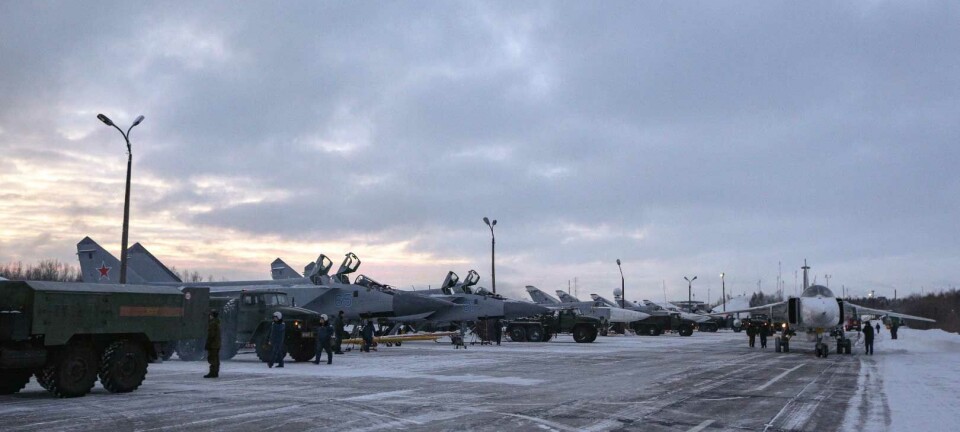
Olenya: From 2000 to today
- 2000–2010: Stagnation & Maintenance. The base functions primarily as a forward base for naval aviation. Activity is low but the runway is kept open for strategic exercises with Tu-22M3.
- 2011–2018: Arctic Rearmament. As part of Russia’s new Arctic strategy, modernization of infrastructure and fuel depots begins to be able to handle heavier bomber aircraft permanently.
- 2019: Tu-22M3 accident. In January, a bomber crashes while landing in a dense snowstorm at the base, leading to increased focus on flight safety and technical upgrades to the runway.
- 2022 (Feb–Dec): Strategic relocation. Following the invasion of Ukraine and Ukrainian drone attacks on the Engels-2 base , Russia moves large parts of its strategic fleet (Tu-95MS and Tu-160) to Olenya for safe storage.
- 2023: Operational center. The base will become a primary launch point for long-range attacks on Ukraine. Satellite images periodically show over 10–15 strategic bombers parked at the same time.
- 2024 (July): The attack. Ukraine carries out a historic drone attack on the base (about 1800 km from the border). According to reports, at least one Tu-22M3 is damaged, proving that the base is no longer out of reach.
- 2025–2026: Permanent Threat. Olenya now serves as a permanent base for Russia’s nuclear triad on NATO’s northern flank, with regular patrols over the Barents Sea.
2. Monchegorsk
Home of the 98th Composite Aviation Regiment. < Wikipedia >. < Route > < Youtube >
- Staffing: Approximately 1,500 – 2,000 people .
- Aircraft:
- MiG-31BM (Foxhound): Approximately 12–16 units (one division).
- Su-24M/MR (Fencer): Approximately 12–20 (attack and reconnaissance versions).
- Mi-8 (Hip): 4–6 units (for search and rescue).
- Luftfarkoster: MiG-31BM (Foxhound): Ca 12–16 stycken (en division).
Su-24M/MR (Fencer): Ca 12–20 stycken (attack- och spaningsversioner).
Mi-8 (Hip): 4–6 stycken (för sök och räddning).
Approximately 1,000 men of the 98th Independent Composite Aviation Regiment maintain the base in Monchgorsk, forty miles southwest of Olenya. < GMap >
The regiment is part of the Northern Fleet’s 45th Air Force and Air Defense Army, one part protecting the airspace of the Kola Peninsula and one serving remote Arctic air bases, including Novaya Zemlya and Franz Josef Land. Fighter defense against NATO aircraft and tactical photo reconnaissance are included in the mission. The pilots are considered skilled, most recently in the Ukraine War. In peacetime, there are about 30 planes at the base. < Base photo > < Base photo >
- 12-18 heavy fighter MiG-31BM (Foxhound) . It is known for its high speed over Mach 2.8, ability to operate at high altitude. The “flying radar station” Zaslon-M radar can track up to 24 targets simultaneously and engage them at a distance of up to 320 km. Operates in the Barents Sea and the Norwegian Sea. NATO’s equivalent is the F 35, also high-altitude and high-speed. < Barents Observer > < Base photo >
- About twenty of the SU-24 attack/bomber aircraft are being phased out. < Wikipedia >

Monchegorsk: From 2000 to today
- 2000–2009: Survival phase. After the fall of the Soviet Union, activity is limited. The base mainly houses Su-24MR (reconnaissance aircraft) and serves as a defensive stronghold to protect the strategic resources of the Murmansk region.
- 2013: Reactivation. Russia begins a major upgrade of the base. A decision is made to permanently station modernized interceptors (fighter aircraft for high-altitude defense) here.
- 2017: The MiG-31 era. The base becomes a hub for the MiG-31BM “Foxhound .” These planes are critical for controlling the airspace over the Arctic and can engage targets at extremely long ranges.
- 2019–2020: Kinzhal capability. Reports indicate that Monchegorsk is being prepared to handle the MiG-31K , the variant carrying the Kinzhal hypersonic missile . Missile storage infrastructure is being strengthened.
- 2021: Increased training activities. The base is used extensively for provocative flights into Norwegian airspace and exercises with the Northern Fleet to simulate defense against NATO aircraft carriers.
- 2023: Su-34s arrive. As a response to the war in Ukraine and increased tension in the north, Su-34s (attack aircraft) are also observed at the base, giving the regiment a significantly sharper offensive capability.
- 2024–2026: Frontline against Finland. Following Finland’s NATO entry, Monchegorsk’s role has shifted from a northern outpost to a direct border base. The readiness is now permanently raised with frequent ”scrambles” (incident readiness) to meet NATO aircraft.
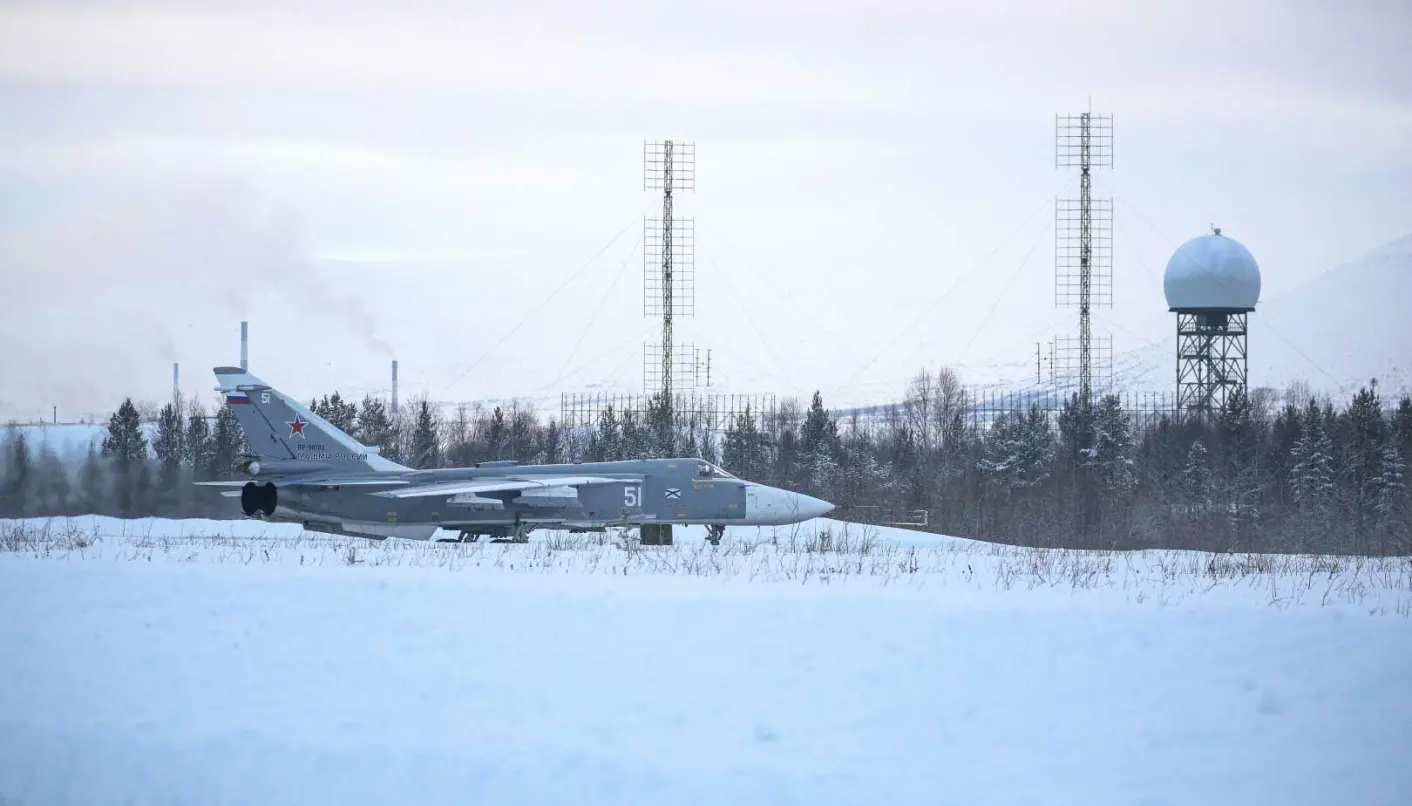
3. Severomorsk-1
Located just south of the city of Severomorsk (headquarters of the Northern Fleet). This is the main naval air base on the peninsula. The base for the ship-based fighter aircraft. < Wikipedia >. < GMaps > < Route > < Map photo > < Youtube > < Youtube >
Ligger precis söder om staden Severomorsk (Nordflottans huvudkvarter). Detta är marinens främsta flygbas på halvön. Basen för det fartygsbaserade jaktflyget. <Wikipedia>. <GMaps> <Rutt> <Kartfoto> <Youtube> <Youtube>
Staffing: Approximately 1,200 – 1,800 people .
Aircraft:
- MiG-29KR /KUBR: Approximately 18–22 (100th Regiment).
- Su-33 (Flanker-D): Approximately 10–14 (279th Regiment, number decreasing as they age).
- Helicopters: The 830th Helicopter Regiment is home to the Ka-27 (Helix), which specializes in operating from ships and hunting submarines. Ka-52K (Katran): 4–8 (naval version of the attack helicopter).
- Aircraft: Il-38 (May) for submarine hunting and reconnaissance, as well as transport aircraft such as the An-26 .
Severomorsk-1 has gone from being a relatively protected base for naval aviation to becoming a direct target for Ukrainian long-range weapons in 2024 and 2025.
Here are the most significant events connected to the base:
- In mid-December 2024, powerful explosions were reported near Severomorsk-1.
- The incident: Local residents filmed columns of smoke and reported shock waves felt several miles away. Analysis from The Barents Observer, among others , pointed to the base as the likely target or location of the incident.
- Interpretation: The footage indicated secondary detonations, which often indicate that an ammunition depot or fuel depot had been hit. Russian authorities downplayed the incident, but satellite imagery later showed traces of fire in the eastern parts of the base.
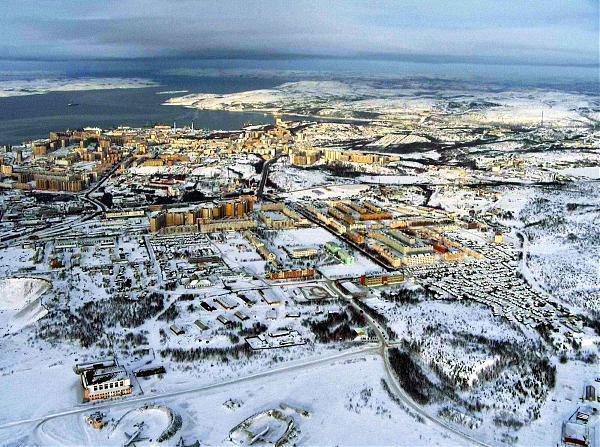
Severomorsk-1 was one of the targets in the massive coordinated drone attack in June 2025.
- Outcome: While Olenya took the brunt of the damage, drones were reported to have reached Severomorsk-1. According to Ukrainian intelligence sources, at least one Il-38 (anti-submarine aircraft) was damaged on the ground.
- Defense response: The incident confirmed that Ukraine’s drones now have the range and precision to operate nearly 200 miles from their launch sites by using infiltrators launching drones from inside Russian territory.

A more prestigious event took place recently, in early 2026.
- The mission: Two Tu-142MK (a naval variant of the Bear plane) from Severomorsk-1 conducted a 30-hour flight over the Arctic that included the first historic aerial refueling at the North Pole itself.
- Purpose: This was a pure show of force to show that Severomorsk-1 can project power across the entire Arctic region and threaten American and NATO submarines deep under the ice.
Reconnaissance towards the NATO exercise ”Cold Response” (March 2026) Right now, in March 2026, the base is very active due to the large NATO exercise in Norway.
- Incident: On March 11, 2026, a Russian Il-20M (electronic reconnaissance plane) took off from Severomorsk-1 and flew deep into the training area off Lofoten.
- Confrontation: Norwegian F-35s took off from Evenes and shadowed the plane for several hours. This shows that Severomorsk-1 remains Russia’s primary platform for monitoring NATO’s northern flank in real time.
As a direct response to the 2024 and 2025 attacks, the base has undergone rapid modernization:
- New protection: Metal nets (so-called “cope cages”) have been installed over the parking lots for the Il-38 planes to detonate drones prematurely.
- Electronic warfare: New jammers have been deployed around the base, leading to reports of civilian GPS signals in the Murmansk region frequently dropping out.
Severomorsk-1: From 2000 to today
- 2000–2011: Decline and recovery. After the Kursk accident in 2000, the navy’s aviation resources are given low priority. The base is mainly used for Il-38 (anti-submarine warfare) and An-26 transport , but the infrastructure is starting to become seriously neglected.
- 2012–2014: The major renovation. Russia temporarily closes the base for a complete renovation. The runway is extended to 3,500 meters and upgraded with modern concrete to accommodate all types of Russian military aircraft, including heavy transport aircraft and strategic bombers.
- 2015: Reopening. The base reopens and becomes the most modern on the Kola Peninsula. It now serves as the primary logistics hub for Russian operations in the Arctic.
- 2016–2018: Tu-142 and submarine hunting. The base becomes the permanent home of the large Tu-142MK/MZ (Bear-F), which are used to track NATO submarines in the Barents Sea and the North Atlantic.
- 2019: Syria logistics. Severomorsk-1 plays a key role in the logistics chain for Northern Fleet ships operating off Syria, where the base is used to fly in spare parts and personnel.
- 2022–2023: NATO shadow. In connection with the war in Ukraine and Finland’s NATO process, readiness increases dramatically. The base is used as a communications center for monitoring NATO aircraft carrier groups in the Norwegian Sea.
- 2024–2026: Arctic Command Center. The base has now solidified its role as the “heart” of Arctic defense. It also houses state-of-the-art Il-38Ns (equipped with the “Novella” advanced targeting system) that patrol the border areas around the clock.
4. Severomorsk-3
The base for ship-based fighter aircraft.
. Satellite images from late 2024 and early 2025 show that new protective hangars and fragmentation shields have been built for the fighter jets (MiG-29K and Su-33). This is a direct response to the threat from small, cheap drones that can cause significant damage to unprotected aircraft. < Wikipedia >. < GMaps > < Route > < Map photo >
In March 2024, the Northern Fleet conducted an unusually specific exercise at the Severomorsk bases. The scenario was that “hostile drones and sabotage groups” had managed to penetrate the air defenses and caused an emergency. It was the first time that Ukrainian methods (small drones) were so openly practiced. Crew: Estimated 1,200 – 1,800 people .
Aircraft:
- MiG-29KR /KUBR:Approximately 18–22 (100th Regiment).
- Su-33 (Flanker-D): Approximately 10–14 (279th Regiment, number decreasing as they age).
- Ka-52K (Katran): 4–8 (naval version of the attack helicopter). Crew: Estimated 1,200–1,800 people .
Severomorsk-3 has gone from being a relatively “calm” training base for aircraft carrier flight to becoming a fortified front-line base that is constantly on high alert for drone attacks.

An interesting aspect of Severomorsk-3 is that it houses the last operational Su-33 (Flanker-D) . There have been several incidents reported in 2024 where these old aircraft were forced to make emergency landings due to material fatigue. There are indications that Russia is now trying to completely phase out the Su-33 in favor of the more modern MiG-29K , but the transition is slow due to a shortage of components.
An interesting aspect of Severomorsk-3 is that it houses the last operational Su-33 (Flanker-D) . There have been several incidents reported in 2024 where these old planes were forced to make emergency landings due to material fatigue. There are indications that Russia is now trying to completely phase out the Su-33 in favor of the more modern MiG-29K, but the transition is slow due to a shortage of components.
Severomorsk-3: From 2000 to the present day
- 2000–2005: The glory days of the Su-33 era. The base is filled with Su-33 “Flanker-D” . Despite Russian economic difficulties, elite pilots are prioritized here to maintain the ability to take off and land on aircraft carriers.
- 2013–2015: Modernization and MiG-29K . A new regiment (100th) is activated at the base, equipped with the more modern and versatile MiG-29K/KUB . The base undergoes asphalting and hangar upgrades to house the new planes.
- 2016–2017: The operation in Syria. Pilots and planes from Severomorsk-3 are shipped out with Admiral Kuznetsov to the Mediterranean for combat missions. Afterwards, they return to base with hard-earned experience (and the loss of two planes during the operation).
- 2018–2021: “Landlocked” elite pilots. With Russia’s only aircraft carrier suffering from accidents and interminable repairs, the base’s pilots are forced to focus entirely on land-based training. Severomorsk-3 will effectively become a regular fighter base with extremely high levels of expertise.
- 2022: Increased readiness. At the outbreak of war in Ukraine, some of the base’s resources are moved to reinforce air defense in the north. The focus is on repelling NATO reconnaissance aircraft approaching the strategic submarine bases.
- 2023–2024: Integration with Monchegorsk. The base is increasingly training with the MiG-31 units from Monchegorsk to create a “wall” of fighter aircraft covering the entire Barents Sea.
- 2025–2026: New role without aircraft carrier. With the future of the aircraft carrier Admiral Kuznetsov uncertain, Severomorsk-3 has been permanently converted into a defensive fighter base with a focus on rapid response (QRA) against NATO expansion in the Nordic region.
5. Alakurtti
Alakurtti is a strategically important Russian air base located in Murmansk Oblast, only about 50 kilometers from the Finnish border . The base serves as a hub for Russia’s Arctic warfare and surveillance of NATO’s northern flank. < Wikipedia > < GMaps > < Map photo>
The base is home to the 80th Motorized Infantry Brigade (often referred to as the ”Arctic Brigade”). Their main mission is to master combat in extreme cold and protect Russian interests in the Arctic, as well as control the land routes to the Kola Peninsula. Alakurtti is primarily a base for helicopter units rather than fighter aircraft. It is usually stationed here:
- Mi-8 (Hip): Transport helicopters equipped for Arctic conditions, used for troop transport and search and rescue operations.
- Mi-24/Mi-35 (Hind): Attack helicopters for fire support.
- Ka-52 (Alligator): Advanced attack helicopters have been periodically observed to strengthen defense capabilities in the border area.
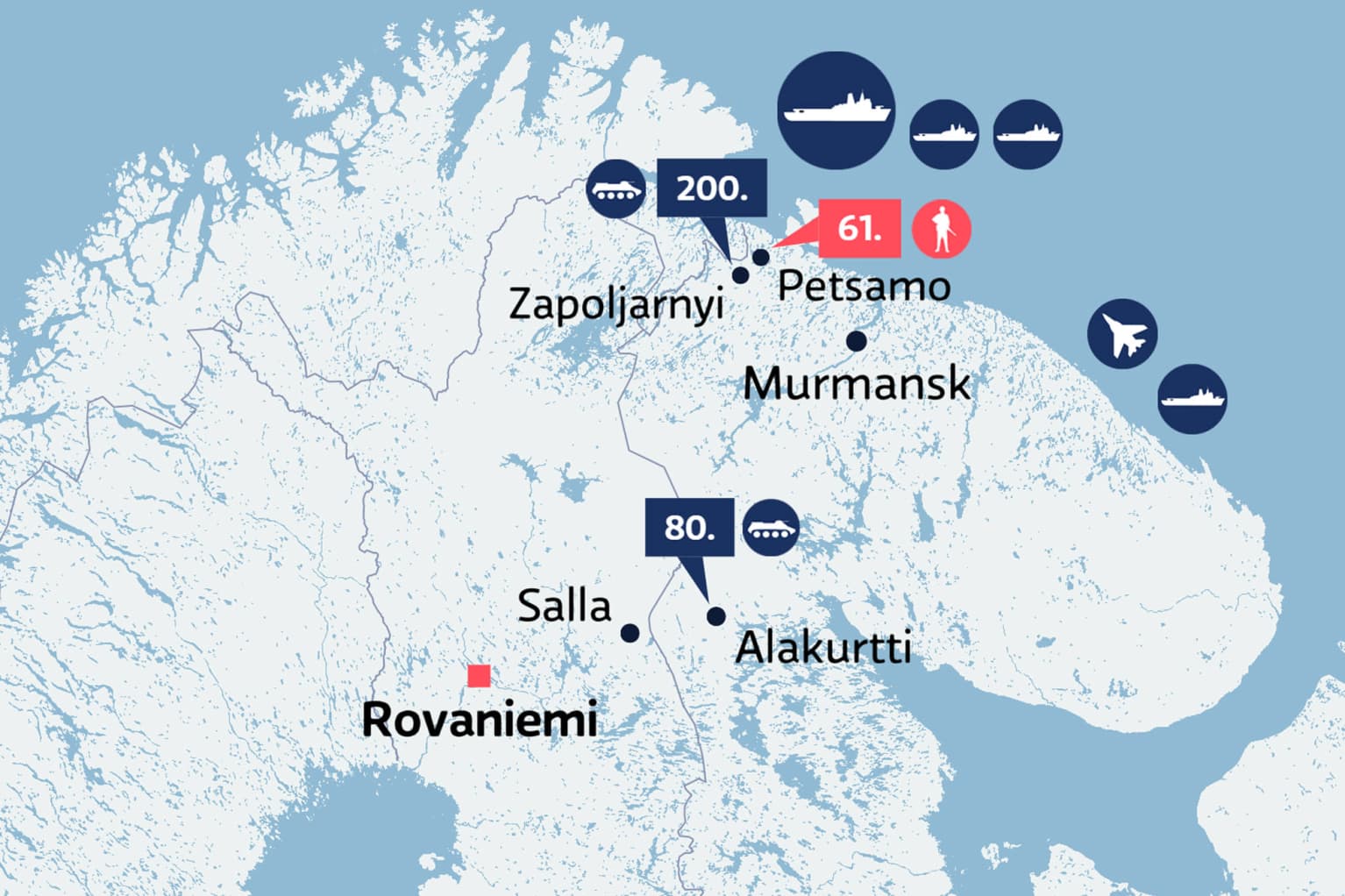
Staffing and infrastructure
- Personnel: The brigade is estimated to consist of approximately 2,000 to 2,500 soldiers , specially trained for snowmobile and tracked vehicle operations.
- Modernization: Since 2015, the base has undergone extensive renovations with new barracks, hangars and heated storage facilities to withstand temperatures down to $-50$°C.
- Preparedness: After Finland’s NATO entry, Russian military rhetoric around Alakurtti has intensified, with a focus on increased presence and rapid response capability.
Alakurtti Air Base (2000–2026)
- 2009: Dismantling. As part of Russian military reforms, the then helicopter unit is disbanded. The base is essentially left deserted and falls into disrepair for a few years, causing concern in the local community.
- 2013–2014: New start in the Arctic. In connection with Russia’s increased focus on the Arctic, a decision is made to reopen the base. Extensive renovations begin to meet modern requirements for polar warfare.
- 2015: The Arctic Brigade arrives. In January, the base is officially put back into service. The 80th Motorized Infantry Brigade (Arctic Brigade) is stationed here with the mission of guarding the border and defending the Kola Peninsula.
- 2017: Air defense reinforcement. Russia deploys advanced air defense systems, including the S-300 , in the immediate area to protect the base and create an “A2/AD bubble” (no-access) against NATO.
- 2019: Helicopter units return. The air base is made permanent as a base for army aviation. A new generation of the Arctic version of the Mi-8AMTSh-VA (equipped with engine heaters and additional insulation) is placed on the base.
- 2022: Impact of the Ukraine War. Reports indicate that parts of the brigade’s personnel and equipment are being sent to the front in Ukraine. The losses lead to a temporary reduction in operational capability at the border.
- 2023–2024: NATO expansion. In response to Finland’s NATO entry, Russia announces plans to reinforce the ”Leningrad Military District.” Alakurtti is identified as a key point to counter NATO’s presence in northern Finland.
- 2025–2026: Modernized infrastructure. Expansion of hangars and runways is completed to handle heavier transport aircraft and more drone systems (UAVs) for border surveillance.
6 Murmansk International Airport
- Murmansk International Airport (MMK/ULMM): Located in Murmashi, about 24 km southwest of Murmansk. This is the region’s main airport for civil aviation with 24-hour operations. It also has a military section used by the FSB for border guarding. < Wikipedia >. < GMaps > > < Route >< Map photo >
- Khibiny Airport (KVK/ULMK) / Kirovsk-Apatity: Located about 15 km south of Apatity, it primarily serves the mining towns of Kirovsk and Apatity, as well as tourism in the Khibiny Mountains.
7. Luotsari (Pechenga)

- Luostari Air Base (also known as Korzunovo): This base is located very close to the Norwegian border (about 15–20 km). < Wikipedia >. < GMaps > < Route > < Map photo >
- Historical note: The base is best known because Yuri Gagarin was stationed here as a fighter pilot before becoming a cosmonaut.
- Current status: Used today primarily as a forward base for helicopter units (such as Mi-8 ) supporting the motorized infantry brigades in the Pechenga area. It has a runway of about 2,400 meters but is rarely used for heavier fixed-wing aircraft these days.
/By Ingemar Lindmark