

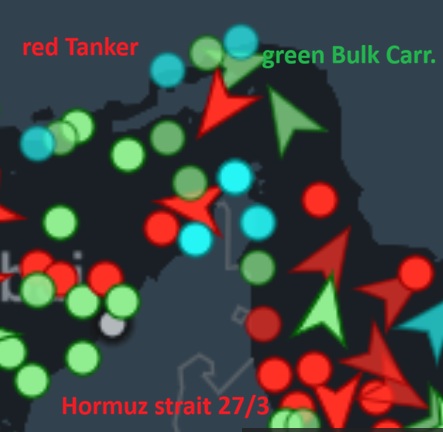
Until Ukrainian drones set fire to ports in the Gulf of Finland. Or…?
- Trump bombed Iran, the Strait of Hormuz was closed, the price of oil shot up like a missile. With inflation threatening to bring down Trump Republicans in the fall elections.
- Zelensky’s drones in the Gulf of Finland are stopping the shadow fleet for now. However, no worse than the oil price shock filling Putin’s war chest.
The Brent crude oil price was stable at around USD 70–73 per barrel at the end of February 2026. The market was then characterized by a certain supply surplus and weaker demand from China. : The discount for Urals oil at Russian ports (FOB) widened sharply and reached levels of USD 28–31 per barrel below the world market price in mid-February.
Indian demand fell to its lowest level since 2022, as Indian refiners hesitated over the risk of secondary sanctions. Chinese independent refiners took advantage of the situation and bought record volumes of Urals oil at discounts of around $12-15 per barrel (including freight to China).
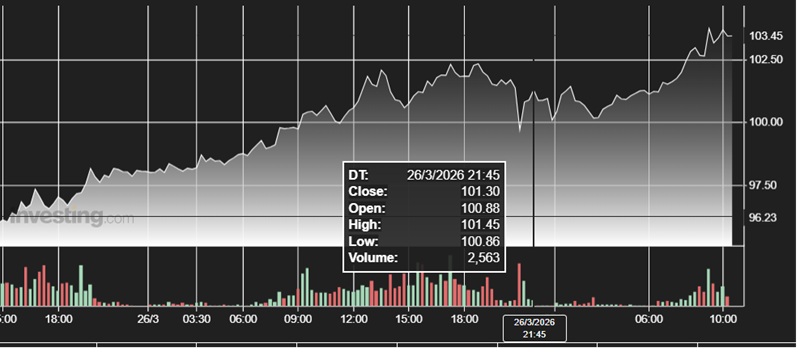
At the first threats and the outbreak of war 28 Feb – 2 March: When the US indicated an attack and the fighting began, the price immediately surged by about 9% to almost USD 80. When the attack on Iran began and the Strait of Hormuz was closed in early March, the game plan changed completely.
Because Russian oil does not have to pass through the blocked strait to reach China, it suddenly became one of the few available sources of raw materials. Despite the surge in world oil prices, the percentage discount on Russian oil initially remained large due to the risk of sanctions. However, by the end of March, the discount began to shrink rapidly as Indian refineries returned to the market. In absolute terms, the price of Urals oil rose from around USD 40 (end of February) to over USD 90 in March.
Hormuz and the Gulf of Finland
During intense fighting in mid-March: In line with reports that Iran had closed or mined the Strait of Hormuz (through which about 20% of the world’s oil passes) and that oil infrastructure had been hit, the Brent price reached a peak of about USD 119.50 per barrel. To be at just over USD 100/barrel by the end of March. This corresponds to an increase of over 60% from the level before the conflict.
End of March: Drones from Ukraine set Russian oil ports in the Gulf of Finland on fire. The price has fluctuated sharply between 100 USD and 108 USD . The market reacts hour by hour to rumors of a ceasefire versus new threats of American attacks on Iranian power plants. In March, India reached record import levels of about 2 million barrels per day , as Russian oil became necessary to replace the loss from Iran and Iraq. China is now paying premiums to secure supplies rather than demanding deep discounts.
Primorsk: < Map > > Mapview > > Photos > < Wikipedia > > Marinetraffic >
Ust Luga: < Map > > Mapview > > Photos > < Wikipedia > > Marinetraffic >
| Factor | Impact on price |
| Strait of Hormuz | The single biggest driving force. Uncertainty around shipping is creating panic in the supply chain. |
| War bounty | Investors add a “risk premium” to the price as long as military presence is high. |
| Strategic reserves | The IEA has considered releasing reserves to cushion the price shock, which has resulted in temporary small price drops. |
Russian oil exports by sea February – March 2026
Export volumes have shown surprising resilience despite the sanctions pressure. Exports were relatively stable in February, but with a slight decline at the beginning of the month due to uncertainty about new sanctions against Rosneft and Lukoil. Volumes ended at around 3.2–3.4 million barrels per day (mb/d) .
After the attack on Iran (28 Feb) there was a clear increase. In the first weeks of March exports rose to an average of 3.44 mb/d , and in some weeks reached peaks of almost 4.0 mb/d . This is because Asian refiners desperately sought alternatives to oil from the Middle East.
Stopped traffic through the Strait of Hormuz is the single biggest reason why the price rose from 70 to 120+ USD.
- Volume loss: Approximately 15–20 million barrels per day (one fifth of world consumption) pass through here. When traffic dropped by 90%, a physical deficit arose that could not be covered by other producers.
- Effect: Created a global shortage situation where Asian refiners began paying extreme premiums to secure oil from elsewhere (e.g. the US and Russia).
The price increase on the world market has had a huge effect on Russian revenues, especially as the discount on Russian oil (Urals) shrank as demand rose in March.
| Scenario | Brent price | Urals price (est. incl. discount) | Daily revenue (approx.)* |
| February (Low) | 70 USD | ~42 USD | 140–150 million USD |
| March (War Ceasefire) | 100 USD | ~75–80 USD | USD 260–280 million |
*Based on an export volume of 3.5 mb/d.
Putin’s night of joy, but…
When the Brent price rose from 70 to 100 USD, it not only meant that the base price went up. Desperation in the market meant that the Russian “punishment discount” (which was around 30 USD in February) shrank to below 10 USD in some contracts during March.
Russia’s daily revenue from crude oil exports nearly doubled in just a few weeks. The Russian treasury received an additional $150 million per day just from the price shock from the Iran conflict. Multiplying by 30, that’s $4.5 billion per month.
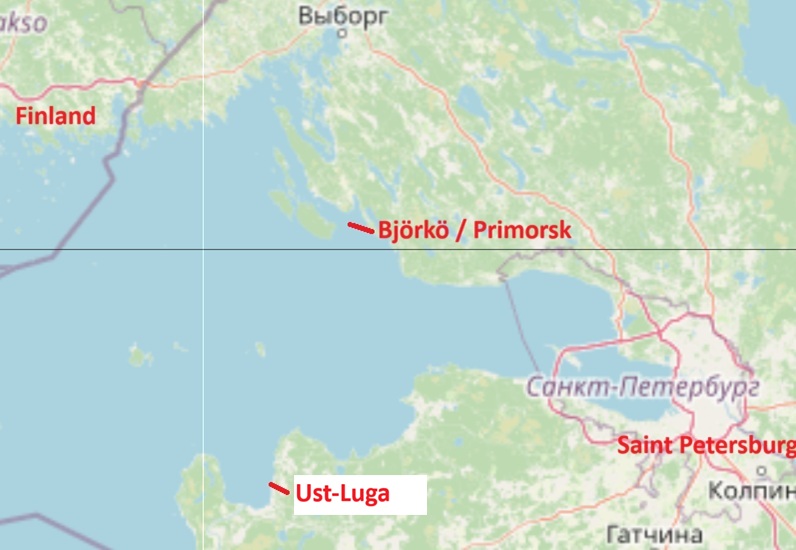
The drone attacks on Russian ports in the Gulf of Finland (primarily Primorsk and Ust-Luga ) in March 2026 created a paradoxical situation in the oil market. While physical supplies were threatened, the global price was pushed up by the uncertainty created by the attacks.
The attacks caused not only temporary outages but extensive damage to infrastructure. : According to analyses by Reuters and other sources in late March, up to 40–50% of Russia’s total export capacity was estimated to be offline or severely disrupted as a result of the drone wave.
With the market already pressured by the Hormuz blockade, drone strikes hit Russia’s most important export routes in the Baltic Sea. Results:
- Crippled infrastructure: The attacks on Primorsk and Ust-Luga in late March knocked out an estimated 40% of Russia’s seaborne export capacity (about 2 million barrels per day).
- Price “floor”: The drone strikes prevented the price from falling back as news of a ceasefire in Iran began to circulate. Investors realized that even if Hormuz opens, Russian supply is now uncertain indefinitely.
Price
As the Black Sea ports (Novorossiysk) were also attacked, Russia was forced to try to divert oil to the port of Murmansk and the Northern Sea Route, which is more expensive and takes longer. This reduced the immediate supply of oil on the world market and kept prices above the $100 USD line .
When news of the fires in Primorsk (March 23) and Ust-Luga (March 25) reached the market, the Brent price reacted with immediate jumps. Although Brent was already high due to the Iran conflict, the attacks in the Gulf of Finland added an additional 0.60-1.00 USD per barrel on each individual event.
Investors realized that Ukraine could now strike at Russia’s main export route in the Baltic Sea, threatening about 1.5-2 million barrels per day . This created fears of a sudden global supply spike in the midst of an ongoing energy crisis.
| Port | Status after the attacks | Economic impact |
| Primorsk | Major damage to cisterns | Exports are severely limited, driving up Brent. |
| Ust-Uga | Loading temporarily stopped | Creates uncertainty for Kazakh exports (KEBCO). |
| Global price | Brent > 100 USD | The drone attacks act as a “floorboard” for the high price. |
The drone attacks created concerns about the price of Russian oil in particular. Tankers (the so-called “shadow fleet”) hesitated to dock at burning terminals, which increased insurance costs and freight rates.
Normally, increased risk should lead to larger discounts on Russian oil. But as the war in Iran simultaneously choked off oil supplies from the Middle East, Asian buyers were so desperate that they accepted the Russian risks. The discount on Urals oil to Brent, which had been record high in February, therefore remained relatively small (under $20) despite the drone threat.
Export
Exports through the Gulf of Finland (Primorsk and Ust-Luga) are the economic engine, despite these ports being targets of attacks in March.
- Gulf of Finland (approx. 45–50%): Generates approx. 130–145 million USD per day . This is where the largest volumes to India and China are shipped.
- Barents Sea (approx. 5–7%): Generates approx. 15–20 million USD per day . This route is considered safer from drone attacks but is limited by logistics and ice conditions.
- Pacific (Kozmino): This route (ESPO oil) has the highest value per barrel, as it is sold at a significantly smaller discount to China.
The price increase to $100 has acted as an economic cushion for Russia. Although physical damage to ports has forced down export volumes, the doubling of revenues per barrel has more than compensated for the loss in volume
Timeline
- February 27: Brent is at USD 73. The market is calm but vigilant on tensions between the US and Iran.
- March 1: US and Israel launch attacks on Iran. Brent immediately rushes to 79–82 USD .
- March 2–4: Iran confirms that the Strait of Hormuz is closed . Tankers are stopped and major shipping companies such as Maersk cancel routes. The price breaks the $100 barrier for the first time in four years.
- March 8: Brent reaches a peak of USD 126. Panic reigns in the market as 20% of the world’s oil is now ”stuck” behind the blockade.
- March 15–20: IEA announces release of strategic reserves (400 million barrels). The price temporarily stabilizes around 105–110 USD .
- March 23–26: Ukraine intensifies drone attacks on the Gulf of Finland (Primorsk and Ust-Luga). The price, which had begun to fall, finds new support and stalls at $108 despite signals of diplomatic mediation in the Iran conflict.
/ By Ingemar Lindmark