

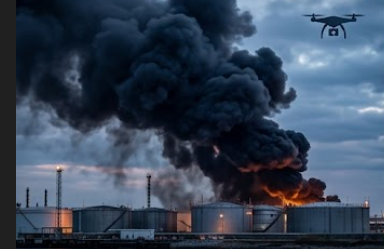
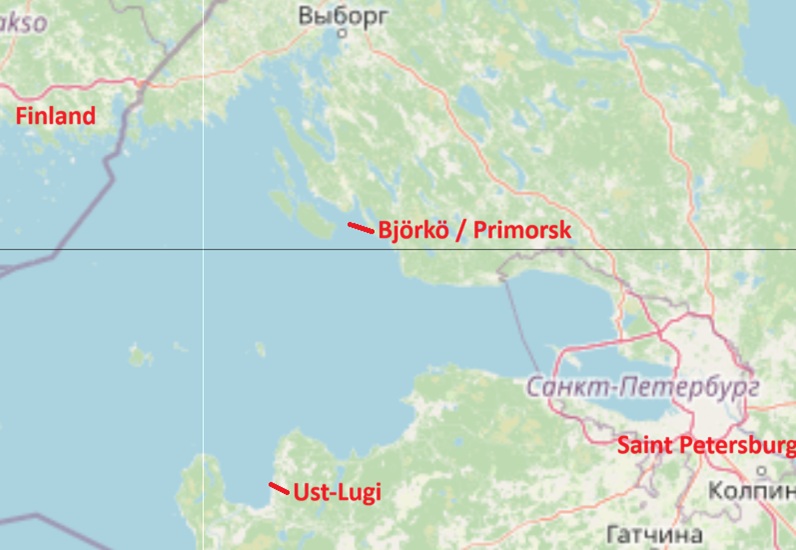
On Monday, March 23, 2026, Ukraine carried out a large-scale drone attack on the port of Primorsk/Björkö, north of the Gulf of Finland, sixty kilometers as the crow flies from the Finnish border. The port is one of Russia’s most important oil export hubs. The attack caused severe fires in several fuel tanks.
< Map > > Mapview > > Photos > < Wikipedia > > Marinetraffic >
The fire in Ust-Luga , which broke out on the night of Wednesday, March 25, 2026 , is described as one of the most successful Ukrainian drone attacks on Russian energy infrastructure to date.
< Map > > Mapview > > Photos > < Wikipedia > > Marinetraffic >
No deaths have been reported in connection with the fires in Primorsk and Ust-Luga, but the economic and logistical damage is estimated to be extensive. The closure of ports is contributing to a further rise in crude oil prices.
Current location Primorsk/Björkö:

- Extent: Satellite images and local reports have confirmed that at least four large oil tanks caught fire. The plume of smoke was so powerful that it was visible as far away as Finland.
- Outage: Exports of crude oil and oil products were halted immediately after the attack. Although Russian authorities claimed that some loading had resumed on Tuesday, international sources (including Reuters and Bloomberg) report continued disruptions and that the port was at times completely closed to deal with the fire.
- Damage to infrastructure: In addition to the tanks, damage is reported to berths (piers 1, 2, 4, 8 and 9). There is also information that two oil tankers that were loading may have been damaged in connection with the attack.
- Connection to Ust-Luga: Just two days later, on March 25 , the neighboring port of Ust-Luga was also hit by drones, which has put almost all of Russia’s oil exports in the Baltic Sea under severe pressure.
Primorsk has the capacity to handle over 1 million barrels of oil per day . The disruptions have already led to a rise in global crude prices, especially as the market is already unsettled due to tensions in the Middle East.
Follow news from Primorsk hour by hour.
Current location Ust-Luga
The fire in Ust-Luga , which broke out on the night of Wednesday, March 25, 2026 , is described as one of the most successful Ukrainian drone attacks on Russian energy infrastructure to date.
- Target: The attack was specifically targeted at Novatek’s large gas condensate processing and unloading facility and the oil terminal.
- Extent: According to both Russian authorities and Ukrainian sources, the facility’s storage tanks and critical loading arms (the equipment that pumps oil/gas to ships) were hit. Footage from the scene shows massive clouds of fire lighting up the night sky.
- Localization: The region’s governor, Aleksandr Drozdenko, confirmed on Wednesday that the fire department was working to ”localize” the fire (meaning they are trying to stop it from spreading, but that it is still burning).
- No injuries: No deaths or injuries have been reported in direct connection to the terminal fire.
Follow news from Ust-Luga hour by hour
Logistical and economic consequences
- Total export halt: All loading of crude oil and petroleum products at Ust-Luga was completely halted on Wednesday. Together with the stoppage at Primorsk, this means that Russia’s primary export routes in the Baltic Sea are currently paralyzed.
- Strategic blow: Ust-Luga normally handles around 650,000 barrels of oil and 150,000 barrels of gas condensate per day. The damage to the loading docks is described as particularly serious because they are more difficult to repair than individual tanks.
- SBU “gift”: The Ukrainian Security Service ( SBU ) has claimed responsibility for the attack, sarcastically calling it a “gift” on the SBU’s anniversary (March 25). They emphasize that the drones flew over 900 kilometers to reach their target.
Repairs
Official statements
- Governor Alexander Drozdenko: Confirmed early on March 26 that the fires in Ust-Luga are now “under control” or extinguished. He downplayed the damage as “minor,” but satellite imagery and eyewitness accounts contradict this, showing extensive damage to loading infrastructure.
- Ukraine’s General Staff: Has released details that the attack was a joint operation between the SBU and other special forces. They confirm that the target was the loading racks and the tank area , which is intended to strangle Russia’s foreign exchange earnings in the long term.
Damage status
- Partial resumption: According to Russian regional sources and shipping data, Ust-Luga has managed to resume some loading operations on the morning of March 26, after aviation warnings were lifted. However, this mainly concerns those parts of the port that were not directly damaged.
- Novatek plant remains at a standstill: The specific gas condensate terminal (Novatek), which was hit hardest, remains shut down. Damage assessment is still ongoing.
- Primorsk still closed: Unlike Ust-Luga, the neighboring port of Primorsk is reported to still be completely closed to loading after the March 23 attack.
Summary of damages
| Place | Main damage | Status 26 mars |
| Primorsk | 4 oil tanks, pumping stations | Severely limited operation |
| Ust-Uga | Novatek terminal, loading docks | Closed (fire extinguished) |
| Vyborg | Military icebreaker, residential building | Damage inventory in progress |
Although Russia is trying to show action by quickly sending ships to dock, experts make the following assessment:
- Emergency repairs (1–2 weeks): Russia is expected to prioritize patching up the least damaged piers to get a minimum flow of oil going.
- Full Capacity (Months): Because Novatek’s fractionation plant and specific loading arms require advanced technology (which is often subject to sanctions), it is estimated that it will take months for Ust-Luga to reach its normal capacity of 7 million tons per year.
Timeline:
Sunday, March 22 – Monday, March 23: Battle of Primorsk
- Monday night: A large-scale drone attack (over 60 drones according to local sources) hits Primorsk , Russia’s largest oil port in the Baltic Sea.
- Damage: At least four fuel tanks catch fire. Smoke clouds spread across the Gulf of Finland and are visible from Finland.
- Effect: All loading of crude oil and diesel is stopped immediately. The price of Brent oil immediately rises to over 103 USD .
- Monday evening: Russian authorities claim that operations are partially resuming, but independent shipping data shows continued and significant disruptions.
Wednesday, March 25: The major attack on Ust-Luga and Vyborg
- 02:00 – 04:00: A new, even more powerful wave of drones (Russia reports a total of 389 drones shot down across the country during the day) reaches Ust-Luga .
- Target: Novatek’s gas condensate and oil products terminal is hit. Several storage tanks and critical loading equipment (loading arms) are destroyed.
- Vyborg: At the same time, the city of Vyborg is hit. One drone damages the roof of a residential building and another is reported to have hit a Russian military icebreaker ( Purga ) that was under construction in the harbor.
- Effect: Ust-Luga is completely closed to all traffic. The port is “isolated” while firefighters fight the fires.
Thursday, March 26: Third night and aftermath
- Thursday night: Reports of drone attacks on the Kirishi refinery (Leningrad region) for the second night in a row.
- Status Ust-Luga: Governor Drozdenko announces that the fire in Ust-Luga is under control, but the terminal remains closed for technical examination.
- Market: Reuters confirms that the combined effect of the attacks in Primorsk, Ust-Luga and Novorossiysk (Black Sea) is now keeping 2 million barrels per day off the market.
/ By Ingemar Lindmark