

How did Ukraine’s special forces manage to send drones to destroy Russian oil ports in the Gulf of Finland? With bombs so heavy they could penetrate the thick sheet metal of an icebreaker at a shipyard in Vyborg.
A good guess is that they were not drones but modified Starlink-controlled drones. Bought cheap off the shelf, like Jetskis were used in the first naval drones. In one case, the FSB’s missile-armed icebreaker was jammed. In the other, a missile corvette and a landing craft were sunk off Crimea. Like David against Goliath, you can get religious for less.
Viborg
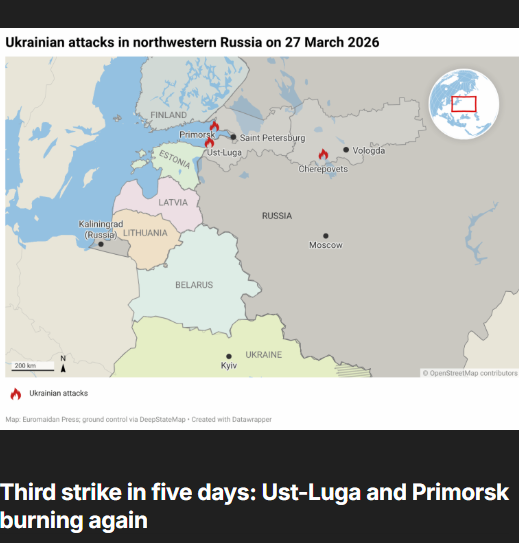
On Wednesday, March 25, 2026, Ukraine carried out a large-scale drone attack on the Vyborg Shipbuilding Plant in the Leningrad region, with converted sport aircraft identified as the likely tools. The attack is historic as it is the first time a Ukrainian drone attack has managed to damage a Russian military ship in the Baltic Sea, almost 1,000 km from the Ukrainian border.
Images from the scene show that the patrol cruiser Purga has suffered a severe list and has partially sunk or lodged against an adjacent research vessel ( Vice-Admiral Burilichev ). This suggests that the drone managed to punch a hole in the hull near the waterline. The ship is called Project 23550, which is under construction for the Russian security service FSB’s coast guard.
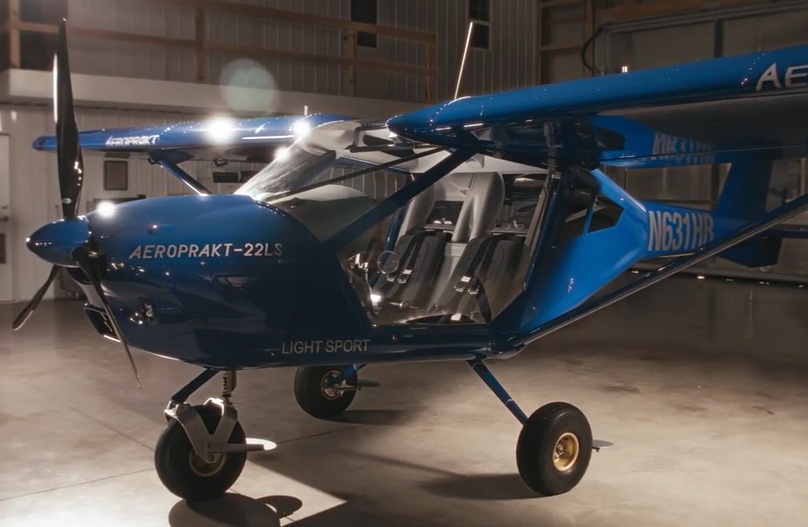
Military analysts, including from Defense Express and Euromaidan Press , assess that Ukraine used remotely piloted sport aircraft (probably Aeroprakt A-22 or the similar model E-300 ).
| function | Kamikaze variant | Bomber variant |
| Life | A flight | Multiple flights |
| Explosive charge | Built into the hull | External (bombs being dropped) |
| Main purpose | Strategic goals (factories) | Tactical targets (ships, supplies) |
| Models | Aeroprakt A-22 | E-300 ”Mountains”, Ninja |
Witnesses in the region filmed aircraft types resembling sport jets at low altitudes during the night of the attack. Reaching all the way to Vyborg requires a range that ordinary small drones lack. A converted A-22 has advantages for such a mission:
- Range: It can fly the 1,000 kilometers from Ukraine, round Belarus and fly up through Russia or over international waters.
- Explosive power: Icebreakers are extremely robust ships with thick steel. A small drone would only do superficial damage. A sport aircraft, on the other hand, can carry hundreds of kilograms of explosives, which is required to actually sink a ship of that size.
- Cost: The icebreaker Purga is valued at over 2.5 billion kronor ($220 million). A used sport aircraft costs a fraction of that, making it an extremely cost-effective attack.
Why airplanes?
Ukraine has on several occasions converted ordinary sport aircraft into remotely controlled “kamikaze drones” to carry out attacks deep inside Russian territory. The most famous example is the Ukrainian-made ultralight aircraft Aeroprakt A-22 Foxbat .
Instead of a human pilot, an automatic control system (robot controller) is installed and the plane is filled with explosives. Since these planes are built for civilian use, they have several advantages in warfare:
- Long range: They can fly over 1,000 km, which is significantly longer than most standard military small drones.
- Low cost: A used sport aircraft or a construction kit is often cheaper than an advanced cruise robot.
- Hard to detect: They often fly low and slow, which can make it difficult for some Russian air defense systems to distinguish them from regular civilian aircraft or helicopters.
Ukraine has developed two completely different ways of using these sport aircraft, depending on how far away the target is and how much explosives are needed.
Kamikaze
This is the most common method for attacks deep inside Russia (over 1,000 km). The plane is filled with as much explosives as it can carry (often up to 300 kg). It is guided via autopilot/satellite all the way into the target.
For extreme distances, it is most fuel efficient to fly in one direction only. In addition, the impact is significantly more powerful when the entire aircraft (including its remaining fuel) acts as one large bomb.
| function | Kamikaze variant | Bomber variant |
| Life | A flight | Multiple flights |
| Explosive charge | Built into the hull | External (bombs being dropped) |
| Main purpose | Strategic goals (factories) | Tactical targets (ships, supplies) |
| Models | Aeroprakt A-22 | E-300 ”Mountains”, Ninja |
Mini-bombers returning
This is a newer and more technologically advanced method that Ukraine has begun using this year, including in the recently reported attacks in the Leningrad region (March 2026) . The sport aircraft are more expensive than small drones. If they can complete the mission and fly back, Ukraine saves money and can use the same plane again the next night.
- The plane (often a modified E-300 “Horynych” ) acts as an unmanned bomber. Instead of crashing into the target, it carries heavy aerial bombs (e.g. FAB-250 of 250 kg) in racks under the wings or fuselage.
- They use advanced optical systems and GPS to drop the bomb with high precision over the target (such as the shipyard in Vyborg) and then turn back home.
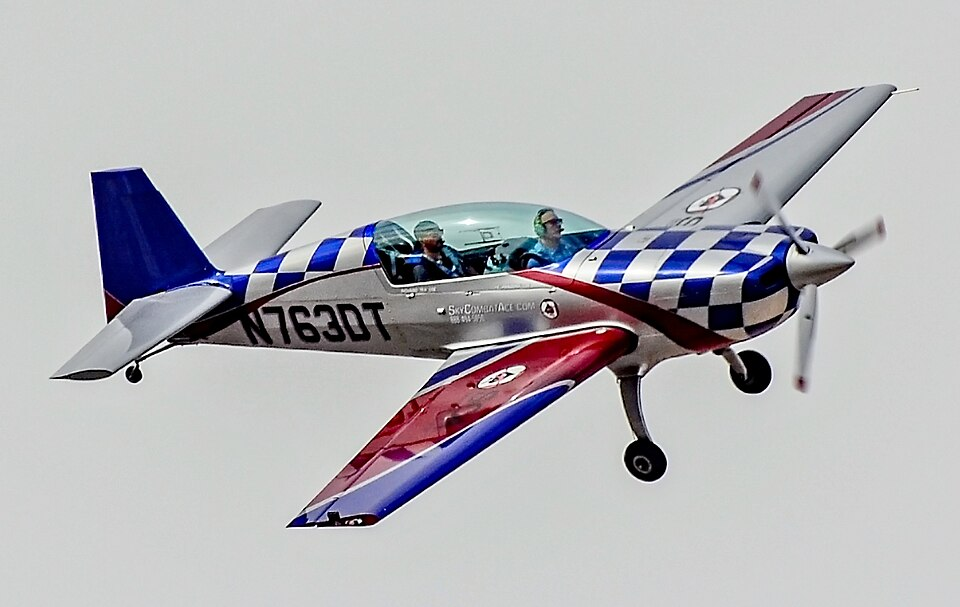
A fascinating development in 2025/2026 is technology where Ukraine uses sport aircraft as aerial tugs .
- The sport aircraft flies like a drone and pulls an unmanned glider behind it on a line.
- The glider is filled with explosives.
- As they approach the target, the glider is released and glides silently the last bit into the target, while the “mother plane” (the sport plane) turns around to safety.
Mini-flights in the air like Jet Ski drones at sea
Just like with sport aircraft, the development of naval drones was about quickly and cheaply solving a huge military problem: How do you sink a fleet without having your own warships?
The Ukrainian strategy
Ukraine’s method is based on asymmetric warfare : using cheap, civilian technology to knock out targets worth billions. By removing the human and adding satellite control (Starlink), they have created long-range weapons without a traditional industry.
Increased distance forces Russia to spread out its air defenses, which disperses resources at the front.
Sport aircraft
- Base: Civilian ultralight planes such as the Aeroprakt A-22 or E-300 .
- Conversion: The pilot is replaced by an autopilot. The plane is filled with approximately 300 kg of explosives .
- Range: Over 1,000 km (can reach deep into Russia, e.g. Tatarstan or Vyborg).
- Method: Either as a kamikaze (crashes into the target) or as an unmanned bomber (drops bombs and returns).
- Advantage: Flies low and slow, making them difficult for modern radar-based air defenses to identify as a threat.
Marine drones
- Base: Components from watercraft (jet skis) , mainly engines and jet units from brands such as Sea-Doo.
- Conversion: Custom-built, extremely low-profile composite hulls equipped with cameras and explosive charges of up to 850 kg .
- Range: Approximately 800 km (covers the entire Black Sea and now also parts of the Baltic Sea).
- Method: Rams the ship’s hull at the waterline to cause maximum water ingress.
- Advantage: The water jet propulsion makes them extremely fast ( 80 km/h ) and maneuverable, while the low profile makes them almost invisible in the waves.
Miniplane – sea drone
Economy: A drone for 1–2 million SEK can sink a ship for 2 billion SEK.
- Innovation: The use of Starlink enables real-time control over enormous distances.
- Surprise: By attacking from unexpected directions (like the icebreaker in Vyborg), Russia is forced to spread its defenses over huge areas.
/ By Ingemar Lindmark