

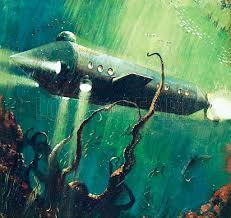
Jules Verne had the Nautilus go under the ice to the South Pole. In 1958 the nuclear-powered Nautilus reached the North Pole. A telegram was sent to President Eisenhower: “Nautilus 90 North .” The military showdown under the polar ice began.
Russian submarines often have dents in their turrets because they push their way up through the ice. In some cases, in a wake. Not because the nuclear reactor needs air, but to send missiles at the enemy in a critical situation.
Different poles, yet striking similarities between the French author’s A Voyage Around the World Under the Sea and modern submarine warfare. The fictional Nautilus is trapped under a toppling iceberg and the crew must hack their way out to get oxygen.
Russian submarines often have dents in their turrets because they push their way up through the ice. In some cases, in a wake. Not because the nuclear reactor needs air, but to send missiles at the enemy in a critical situation.
The stealth submarines
Modern submarines are extremely quiet thanks to rubber-covered hulls and the propeller mounted inside a tunnel. The US has about thirty such submarines in the North Atlantic ( Virginia and Los Angeles ). Great Britain and France have six each. Russia’s Northern Fleet has 3-4 attack submarines that match the Virginia class. In addition, five large nuclear-powered missile submarines, often under the polar ice in the Barents Sea – protected like a bastion by about twenty older diesel-powered submarines.
Historically, the US has a big lead, but fourth-generation Russian submarines are now considered to be on par with the best Western ones. The difference in decibels is so small that it comes down to who has the best sonar operators and environmental adaptation.
USA/NATO: The Virginia class and the British Astute class are believed to be the best, however. Their strength lies not only in their hulls, but in advanced sensor systems and anechoic layers that make them difficult to detect even with active sonar.
| Category | Russia | USA / NATO |
| Strategic missile submarines ( SSBNs ) | ~12 (8 Borej, 4 Delta IV) | ~18 (14 Ohio, 4 Vanguard/Triomphant) |
| Attack submarines ( SSN/SSGN ) | ~25–30 (Of which ~6-8 Yasen-M) | ~60+ (Virginia, Los Angeles, Astute, m.fl.) |
| Conventional ( SSK ) | ~20 (Kilo/Pepper) | ~50+ (German, French, Swedish, etc.) |
NATO has a numerical advantage, especially if you include European modern conventional (diesel-electric) submarines that can be extremely quiet in coastal waters. An example is six Swedish Stirling engine submarines ( Gotland /Västergtland class).
Today, Russian submarines are almost as quiet as those of the West. Although NATO’s reconnaissance is superior, with satellites and more advanced electronics. The ability to hide under the ice cover is Putin’s trump card, not least along the pack ice along eastern Greenland. Because the noise from the ice drowns out listening with sonar. The West is therefore testing sensors sensitive to cooling water emissions from the boats’ nuclear reactors. The Russians are countering with sniffers to track oil and other chemicals. An arms race in the style of Jules Verne.
The cat on the rat
Russia’s strategy:
Protects nuclear-armed submarines (Borei) in heavily defended areas in the Barents Sea and the Sea of Okhotsk with so-called bastion defenses. The Yasen class is designed to be able to fire cruise missiles (such as Zircon and Kalibr) against aircraft carrier groups and land targets, rather than just hunting other submarines.
The task of the submarines in the Atlantic is to prevent shipping from the US to Western Europe. An increasingly important task is to cut underwater cables for the internet and power lines (via special units such as GUGI).
USA/NATO strategy:
US submarines operate far from home, shadowing Russian ships directly at their bases. NATO is investing in “Digital Ocean”, where submarines fixed sensors on the seabed ( SOSUS successors) cooperate with reconnaissance aircraft, buoyancy sensors and autonomous underwater drones ( UUVs ).
NATO has more submarines and a technological ecosystem of sensors and drones that makes it extremely difficult for Russian submarines to move undetected in, for example, the Atlantic or Baltic Sea.
The Atlantic Lock
The GIUK gap (Greenland, Iceland, United Kingdom) is a strategic “gateway” in the North Atlantic. Russian submarines from the Northern Fleet must pass through to reach it and threaten sea connections between the US and Europe. < GMaps >
The gap is a high-tech cat-and-mouse game. While NATO is investing in making the sea “transparent” with billions of sensors, Russia is investing in extreme silence and asymmetric methods to blind the sensors. NATO sees the GIUK gap as its first line of defense in the Atlantic. The surveillance is a network with several layers:
- IUSS & SOSUS (Underwater Listening): A network of fixed hydrophones is located on the seabed. They are being upgraded with digital technology to be able to detect even the silent Russian submarines (Borej and Yasen).
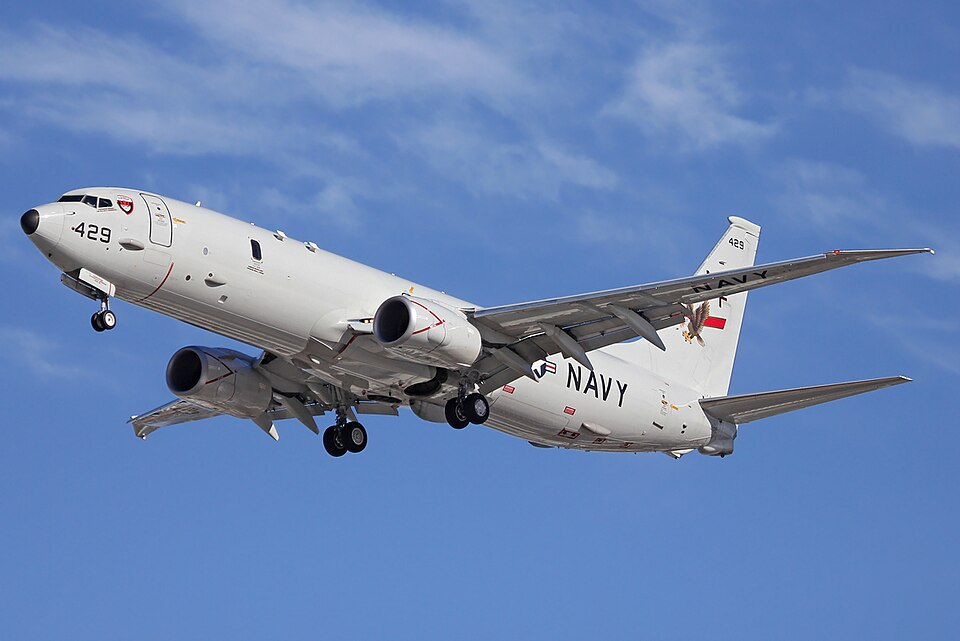
- P-8 Poseidon (Anti-Submarine Warfare): Aircraft based in Iceland (Keflavík), Scotland and Norway patrol the area 24/7. They release sonobuoys that create a temporary, dense network of sensors in the water.
- Attack submarines: American, British and Norwegian submarines lie in “ambush” in the gap to pick up the tracks of Russian ships as soon as they leave their bases on the Kola Peninsula.
- Drones and sensors: NATO also uses autonomous underwater vehicles (UUVs) that can stay out for months waiting for acoustic signatures.
For the Russians, passing unseen is essential in order to threaten shipping in the Atlantic or cut undersea cables.
- Deep Diving & Ice: Russian submarines often use the Arctic ice cap to mask their sound. By diving extremely deep or hiding under the moving ice masses, they become more difficult for aircraft to find.
- Acoustic masking: Russian submarines often move very slowly (“ultra-quiet speed”) as they approach the gap. They try to mask their sound behind large merchant ships or natural noise sources such as whales and tectonic activity.
- Disguise: Russia could send out older, noisier submarines (such as the Kilo or Akula class) as decoys to attract NATO’s attention, while a state-of-the-art Yasen-M sneaks by in another sector.
- Sabotage of sensors: A major concern for NATO is that Russia, via special vessels such as the Jantar, is trying to locate and physically manipulate or cut the cables that feed the SOSUS network with data.
- Deep trenches and biology: Deep-sea trenches and areas with a lot of biological noise (whales, schools of fish) are used to mask their acoustic signature.
- Operation Atrina tactics: In well-known operations (such as the historic Atrina in 1987), the Soviets sent several submarines simultaneously along unusual routes – for example, close along the east coast of Greenland under the ice – to overwhelm NATO’s analysis capacity.
The Bastion in the Barents Sea
The Russian bastion defense in the Barents Sea is a defensive strategy that seeks to secure the ports of strategic nuclear submarines (SSBNs). The core of the bastion is the military facilities on the Kola Peninsula, strategically located in relatively ice-free waters near the Norwegian border.
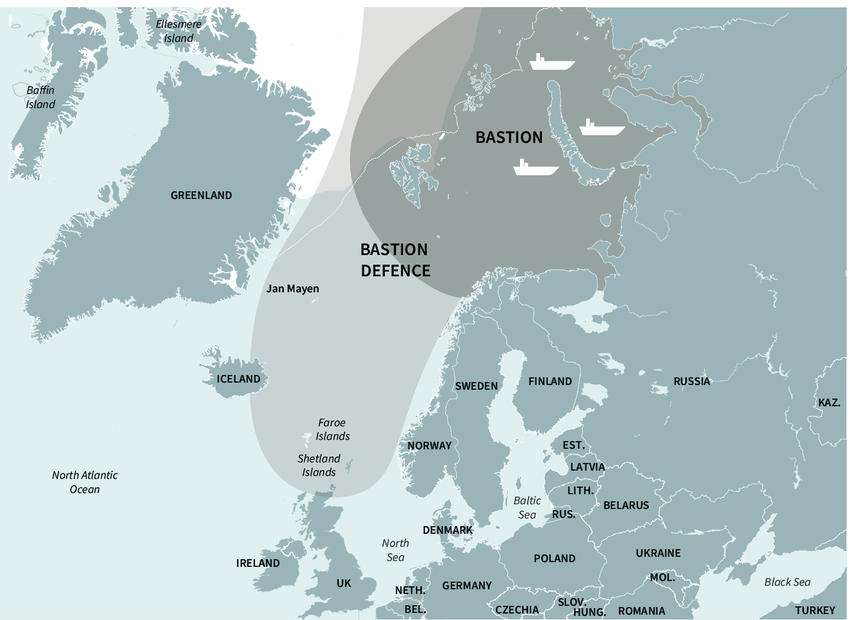
The goal of the bastion is to guarantee a second-strike capability. If a nuclear war were to break out and Russia’s land-based missiles were destroyed, the Borei submarines would be safely hidden under the ice or behind sensor systems in the Barents Sea. NATO’s response to this is an increased presence with submarine chasers and its own nuclear submarines that are trained to operate in cold environments.
- Gadzhiyevo: The primary base for the most modern Borei and Borei-A submarines. It houses heavily guarded facilities for maintenance and storage of nuclear warheads.
- Severomorsk: Headquarters of the Northern Fleet. From here, surface combat ships and aircraft are coordinated to protect the “walls of the bastion.”
- Okolnaya Bay: A huge transshipment station for heavy missiles (SLBMs) such as Bulava and Sineva.
- Protection: The area is covered by extremely dense air defense (S-400 and S-500) as well as coastal missile batteries (Bastion-P) that can sink enemy ships far out to sea.
Russia’s Pearl Harbor and other air bases near Murmansk
Russian outpost
The bastion is guarded by Yasen-M class attack submarines, which act as watchdogs. Their task is to chase away or sink NATO submarines (such as the American Virginia class) before they can find the Russian nuclear submarines. The Russian submarines have reinforced turrets to be able to break through the ice and fire their missiles directly from a watch.
Borei-class submarines are built to operate under the thick pack ice north of the Barents Sea. The ice moves, cracks and scrapes, creating a strong background noise. This makes it almost impossible for enemy sonar to distinguish a silent submarine from the natural sound of the ice. Russian nuclear submarines (Borei-class) prefer to lie just north of the ice edge , under the pack ice. The ice edge creates an acoustic noise as the ice floes collide and melt. For a NATO submarine trying to listen for a Russian submarine, this is very difficult. The Russian submarine lies “silently” under the ice, while Russian attack submarines (Yasen-class) patrol the open waters just south of the ice edge to act as gatekeepers.
Russian submarines actively search for natural openings in the ice. When necessary to launch their ballistic missiles, they can quickly slide up into an opening. If the ice is thin (up to about 2–3 meters), they can break through it with the turret to reach a firing position, protected from air attack right up until the moment of launch.
The ice is melting
If a NATO submarine tries to sneak into the bastion, Russia has installed an advanced sensor system called Garmonija (Harmony). At a depth of about 80 meters in the Barents Sea, stationary hydrophones are located that sound an alarm at the slightest vibration. Reports show that Russia has managed to expand this with the help of smuggled Western technology despite sanctions.
The ice is like an upside-down archipelago where submarines find their way in cracks between the ice keels. Which acts as a kind of “chart” to navigate by. Dead reckoning is practiced, without support from stars and navigation satellites. The only contact with the outside world is to emerge in a wake to send/receive messages for a few seconds.
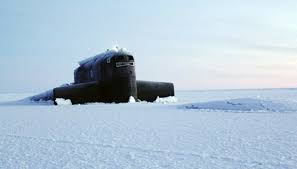
Or the wake is created by a heavy icebreaker that can break three meters of ice. Russia has about ten icebreakers in the Arctic Ocean, seven of which are nuclear-powered. The US and NATO countries have hardly any in these waters. If NATO leads 1-0 in the North Atlantic, the reverse applies to Russia’s advantage along the polar ice.
The ice edge in the Barents Sea is not a straight line, but a dynamic and seasonal boundary that plays a crucial role in how the Russian Northern Fleet operates. The ice edge is influenced by the warm Norwegian Atlantic Current , which is an extension of the Gulf Stream.
- Western and southern parts: Due to the warm Atlantic waters, the southwestern part of the Barents Sea (off the Norwegian coast and Murmansk) is largely ice-free year-round . This is why Russia’s most important submarine bases are located here.
- Northern and eastern part: The ice edge usually starts north of Spitsbergen and extends southeast towards Novaya Zemlya. During the winter (March/April) the ice can creep far south, while during the late summer (September) it retreats far north, sometimes as far as the 80th parallel.
- The 2026 trend: Global warming has made the ice edge more unpredictable and thinner, which Russia is compensating for by moving its operations further north.
Where the cold, sweeter meltwater from the ice meets the saltier, warmer Atlantic water, strong layers of water are created where the temperature changes drastically. These layers bend sound waves from sonar. Russian submarine commanders are experts at “hiding under the layer,” making them almost invisible to sonar on ships or helicopters at the surface.
Russia (and also the United States via Operation Ice Camp ) uses temporary bases on drifting ice floes to deploy sensors and act as command centers.
Svalbard
The ice edge is not just a climatic boundary, but a tactical front line . The further north the ice retreats, the harder it becomes for Russia to conceal its submarines, forcing them to invest more in fixed sensors on the seabed to maintain the integrity of the bastion. Which puts Russia’s focus on:
- Svalbard /Spetsbergen in the west. < GMaps >
- Franz Josef Land in the north.< GMaps https://maps.app.goo.gl/H1ZoADPEHgLxBvYZ6 >
- Novaya Zemlya in the east. <GMaps>
Along this line, Russia is deploying mobile sensors on the ice and underwater. The ice edge becomes a kind of “warning line”; if a NATO submarine crosses it into the ice-covered area, it is forced to operate in an environment where Russian submarines have a home-field advantage and know the bottom conditions in detail.
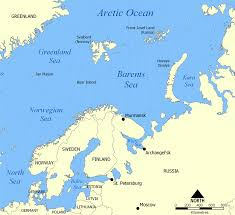
Russian research vessels or fishing vessels with a suspiciously large number of antennas are seen moving around Svalbard to monitor the fiber cables that run along the seabed to Norway.
Svalbard is extremely difficult for Norway and NATO to defend. The Svalbard Treaty from 1920 limits military presence, the area should in principle be demilitarized. Long and isolated location , it is difficult to quickly send reinforcements. Harsh climate – cold, darkness and ice make military operations difficult. Russian presence in Barentsburg is politically sensitive.
Svalbard (Spetsbergen) is a complicated factor because of the Svalbard Treaty . According to it, Svalbard may not be used for war purposes or have military bases. Russia is terrified that NATO will secretly install sensors or radars on Svalbard that look right into their bastion.
The Bear Line
The “ Bear Gap ” is the military strategic line between the North Cape in Norway and Bear Island (Björneöya), and up towards Svalbard . Which is the most critical bottleneck in the Russian bastion defense. If the GIUK Gap is the outer gateway to the Atlantic, the Bear Gap is the same as an outpost to Russia’s most important military zone.
- NATO’s goal: To detect and start shadowing Russian submarines right here. If you lose a Russian submarine at the Bear Line, it’s much harder to find it once it reaches the deep graves of the Norwegian Sea.
- Russia’s goal: To ”break through” silently. Russian submarines often exploit the deep trenches in the seabed around Bear Island to try to slip below the sound barrier.
The Bear Line is the “tripwire” line in the north. This is where the risk of a conflict between NATO and Russia begins. This is the area in the world where the density of hidden sensors and advanced submarines is at its highest in 2026.
South of the Bear Line, NATO dominates, mainly through Norway and the USA. North of the line, in the Barents Sea, begins the area where Russia strives for total military control (the Bastion). For a Russian submarine heading out into the Atlantic, the passage past Bear Island is the most dangerous moment. Here the sea narrows and surveillance is at its densest. For NATO, the Bear Line is the “alarm”. If a Russian Yasen-M submarine crosses the line south, the threat level to Europe and the US East Coast is considered to have immediately escalated.
Greenland’s ice belt
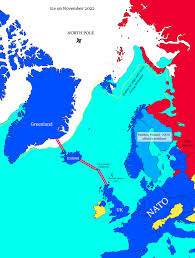
In winter, pack ice can fill almost half of the Denmark Strait, the thirty miles between Greenland and Iceland. In late summer, it covers only a few miles off the coast. The ice moves, cracks and rubs against each other with sounds that drown out what a stealthy submarine can hear. Passive sonars malfunction and cables are damaged by icebergs. The meltwater from these creates cleverly distorted sound waves. <GMaps>
The ice prevents effective reconnaissance from satellites and aircraft (like the P-8 Poseidon) that cannot drop sonar buoys through the pack ice. NATO has to rely on its own attack submarines under the ice to shadow the Russian ships. Lie in ambush, silent for weeks and months. No slamming pots, even the playing cards are soft.
Reconnaissance under ice is risky and technically challenging due to the movement of the ice. NATO has responded to Russian advances (especially the silent Severodvinsk-class submarines) by re-establishing bases, such as at Keflavík in Iceland, and developing unmanned underwater vehicles (UUVs) that can lie in wait at the ice edge.
During the Cold War, NATO sonars were so sensitive that they could identify individual Soviet submarines by their unique propeller sounds, but today’s Russian submarines are so quiet that the margins for detection have shrunk to just a few kilometers.
- Sensors on the seabed: Upgrading fixed hydrophone systems (like the old SOSUS systems) which are now being updated with modern digital technology to better distinguish between natural ice noise and engine noise from submarines.
- Participation in “ Arctic Endurance ”: The Danish-led Arctic Endurance exercise series is used to test new systems for underwater communication and autonomous underwater vehicles (UUVs) that can patrol under the ice cover where manned vessels cannot reach.
Icebreaker
The US and NATO have taken strong action to break Russian icebreaker dominance in 2024–2026. Russia has long had a massive advantage with around 40 icebreakers (several of which are nuclear-powered), while the US fleet has been critically undermanned with only a few aging ships.
To balance this, NATO countries have created a new strategic alliance and are investing heavily in new production. In July 2024, the ICE Pact (Icebreaker Collaboration Effort), a collaboration between the United States, Canada and Finland, was launched . This is the most important step in matching Russia.
- Purpose: To pool expertise and production capacity. Finland has built over half of the world’s icebreakers and contributes technical know-how, while the US and Canada provide financing and large-scale production.
- Goal: To produce between 70 and 90 Arctic-capable ships over the next decade to secure a presence in the Arctic and counter Russian and Chinese influence.
The United States has accelerated its own programs to replace its aging ships in early 2026:
- Polar Security Cutter (PSC): The Heavy Icebreakers program. These are the most powerful vessels that will be able to operate in the thickest ice and carry weapons systems if necessary.
- Arctic Security Cutter (ASC): In February 2026, the US Coast Guard finalized the contract award for 11 new icebreakers in this class. These will form the backbone of the new Arctic fleet, with first deliveries expected in 2028.
- Light Icebreakers: In addition to the heavy vessels, up to seven lighter icebreakers are also planned to secure trade routes and coastal waters.
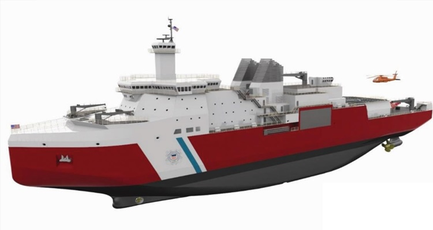
Within NATO, the focus has shifted from just ”monitoring” to actually being able to ”act” in the ice.
- Canada is carrying out a massive rearmament with plans for 16 new icebreaking multi-purpose vessels and 6 medium-duty icebreakers.
- Sweden and Finland contribute world-leading expertise in icebreaking and winter warfare. Swedish membership means that NATO’s planning for the North Atlantic now includes access to Swedish icebreakers in the Baltic Sea if needed.
2026
NATO has intensified its presence and technical capabilities in early 2026 to monitor underwater activity in Arctic waters, particularly along the east coast of Greenland and the strategic GIUK gap (Greenland-Iceland-UK).
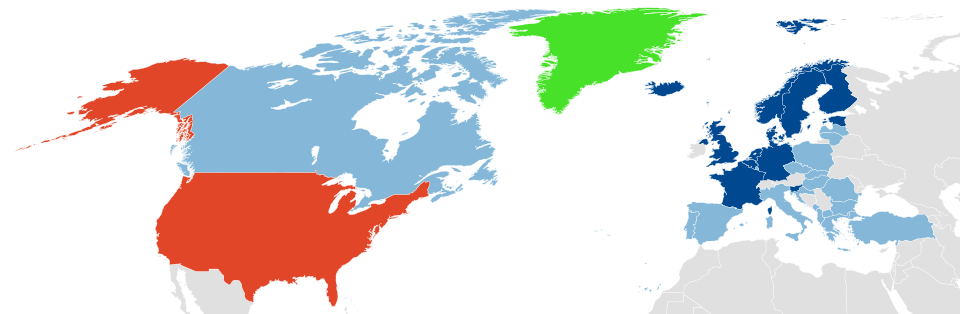
The strengthening of submarine surveillance is mainly done through three tracks: the new operation Arctic Sentry , increased technical surveillance and closer Nordic cooperation. In February 2026, NATO launched Operation Arctic Sentry . This is a permanent coordinated operation that aims to increase situational awareness in the Arctic.
- Purpose: To create a coherent picture of what is moving below and on the water surface to detect Russian submarines attempting to pass unseen from the Arctic Ocean into the Atlantic.
- Participation: Sweden, Denmark and the UK play key roles. Sweden is contributing, among other things, JAS 39 Gripen for surface surveillance, while the UK plans to send an aircraft carrier group (led by HMS Prince of Wales) to the area in 2026.
Since the turn of the year 2025/2026, Sweden has been included in NATO’s new area of operations under Joint Force Command (JFC) Norfolk . This means that Swedish expertise in submarine hunting and intelligence gathering is now directly integrated into the protection of the North Atlantic.
- Air base hunters and special forces: Swedish air base hunters have been training in Greenland together with Danish forces in early 2026 to secure infrastructure required to support reconnaissance aircraft (e.g. P-8 Poseidon) which are crucial for submarine hunting.
The need for strengthened monitoring has become urgent in 2026 due to two factors:
- Russian activity: Russia has increased its attempts to demonstrate a presence in the area to secure its own strategic submarine routes.
- Geopolitical uncertainty: Renewed American interest in the status of Greenland has created a need for European NATO allies to demonstrate a strong and unified presence to maintain stability in the region.
GIUK gap timeline
1960s: SOSUS is established
- The US is expanding the SOSUS hydrophone chain from Greenland via Iceland to the UK.
- The system becomes the backbone of NATO’s early warning against Soviet submarines.
- Soviet diesel-electric submarines regularly pass the GIUK gap for the Atlantic.
1970s: Soviet nuclear submarines
- The Soviets introduce the Victor, Charlie, and Delta classes , which increase range and endurance.
- NATO is intensifying ASW patrols with P-3 Orion, Nimrod and frigates.
- SOSUS provides high accuracy on Soviet submarine movements through the gap.
1980s: Quieter submarines and intensive ASW
- The Soviets launch the Akula class , significantly quieter than before.
- NATO responds with more surface battle groups, submarine chase exercises, and air patrols .
- The GIUK Gap will become one of the world’s most monitored sea passages.
- The US and UK are conducting covert surveillance operations near the Kola Peninsula.
1990s: Decreased activity
- The fall of the Soviet Union greatly reduced the activities of the Northern Fleet.
- The SOSUS system is being partially phased out or converted to research.
- NATO reduces ASW presence; GIUK gap gets lower priority.
2000s: Low-intensity surveillance
- Russian submarine activity remains but at a low level.
- NATO focuses on expeditionary operations rather than the North Atlantic.
- The Keflavík base in Iceland was closed in 2006 for permanent American presence.
2010s: Russian comeback
- Russia is modernizing the Northern Fleet with the Borei and Yasen classes .
- More Russian submarines are conducting deep-sea patrols in the North Atlantic.
- NATO resumes regular P-8 Poseidon flights from Iceland and the United Kingdom.
- 2019: Major Russian exercise tests passage through the GIUK gap with multiple submarines simultaneously.
2020s: Renewed NATO focus
- The GIUK gap is redefined as the main strategic axis for NATO’s Atlantic defense.
- The US re-establishes a permanent rotational presence at Keflavík.
- Enhanced underwater sensor technology , including modernized hydrophones and unmanned systems.
- Increased Russian activity in the Arctic makes the gap central to tracking strategic submarines (SSBNs) and attack submarines (SSNs) .
- The UK and Norway are intensifying joint ASW operations in the North Atlantic.
/ By Ingemar Lindmark