

Good for Ukraine, but after the Hormuz blockade, the oil crisis will intensify.
During the period 5–6 April 2026, the oil terminal in Primorsk was subjected to one of the most extensive drone attacks to date, which, combined with earlier attacks in March, paralyzed large parts of Russian oil exports in the Baltic Sea. The loading of oil products had to be immediately interrupted. Black columns of smoke were visible from the Finnish side of the border.
On the night of April 5, 2026, Ukraine’s Unmanned Systems Forces carried out a coordinated attack on several Russian energy targets. A total of 87 drones were fired at Russian territory, 19 of which were aimed at the Leningrad region and specifically Primorsk.
Traffic in Primorsk during the first week of April 2026 is almost paralyzed. Today, April 7, only one of the three berths is servicing a tanker. According to the same source, Marine Traffic, only one tanker from the shadow fleet is visible departing Primorsk on the route down to Gotland. Can be interpreted as the only delivery during the last 24 hours, with the reservation that captains may have turned off the ship’s AIS.
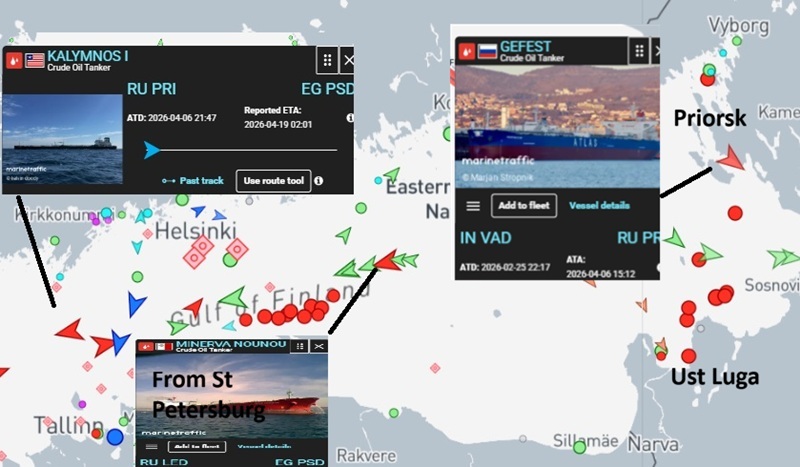
The governor of the Leningrad region, Aleksandr Drozdenko , confirms that debris from downed drones hit the facility. Initial reports of a damaged pipeline were later corrected to fuel tanks catching fire .
Russian oil companies have begun installing their own “anti-drone towers” and protective nets around critical valves, but the April 5 attack showed that the existing systems ( Pantsir-S1 ) were inadequate against swarms of drones.
See “ Swedish horror scenario , how to get rid of two stateless shadow ships that have no owner”.
March/April
For the period 1–7 April 2026, tanker traffic from Primorsk will be characterized by dramatic disruptions as a result of Ukrainian drone attacks and interventions against the Russian “shadow fleet”.
On the morning of the attack, Pulkovo Airport in Saint Petersburg was completely closed, and civilian flights over northern Europe (including Finland) had to be diverted due to the intense activity of Russian air defenses.
The days following the attack were marked by chaos in the port and uncertainty in the global market. On 6 April it was reported that the terminal was essentially out of service. Several ships that were berthed were forced to put out to sea for safety reasons while firefighting was underway in the tank area.
According to analyses (including those from the Kyiv School of Economics), the attacks on Primorsk and the neighboring port of Ust-Luga contributed to Russian energy exporters losing nearly $1 billion in revenue in just one week.
Claim status April 7, 2026
One or more tanks are leaking oil. Damage to pumping systems and control nodes has been reported, making it difficult to resume full capacity even after the fires are extinguished.
Analysts estimate that Russia’s total export capacity in the Baltic Sea fell by about 40% as a result of these combined blows. The Ust Luga oil terminal has been closed to deliveries since the fires. Only one Russian tanker is visible at the quay. From Marine Traffic’s map of the Baltic Sea, only one tanker is visible (in Bornholmsgattet) with Ust Luga as the departure point. Only bulk goods (coal/commercial fertilizer?) are currently shipped from this port.
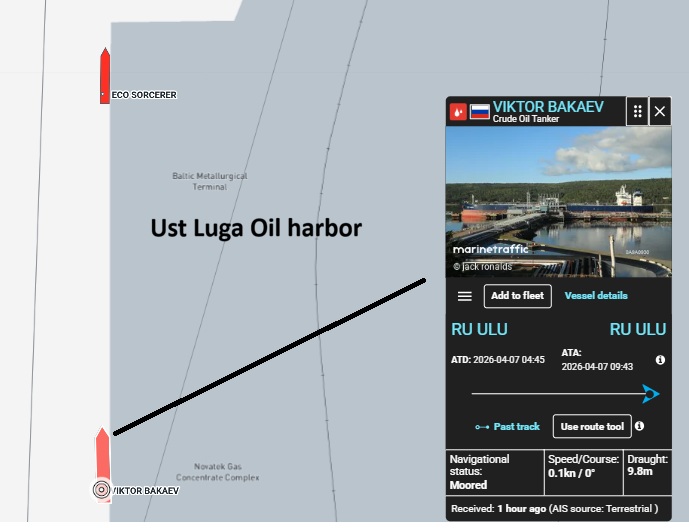
This escalation has led to Russian ships now increasingly trying to “darken” their positions (turn off AIS) in the Gulf of Finland to avoid becoming targets for new waves of attacks.
Two out of three piers are fire damaged
Export capacity in Primorsk has been severely affected following a series of drone attacks in late March and early April. As of 5 April 2026 , no tankers were reported to have docked at the terminals. Instead, ships are anchored in the roadstead awaiting repairs to damage to piers 2 and 4 (which caught fire during loading).
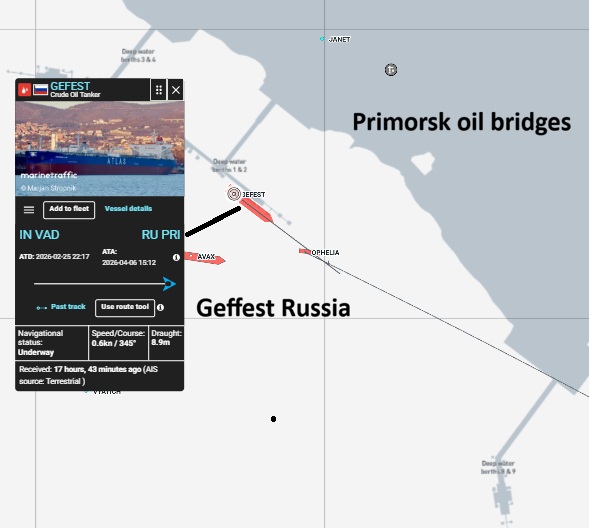
About half of the port’s oil storage capacity is said to be temporarily out of service, it has been reported. In the week leading up to April 1, the number of departures from Primorsk fell from the normal 10 tankers per week to just four. Marin Traffic’s map shows at least six ships from the shadow fleet departing RU-PRI, a 2-3 day journey from Primorsk.
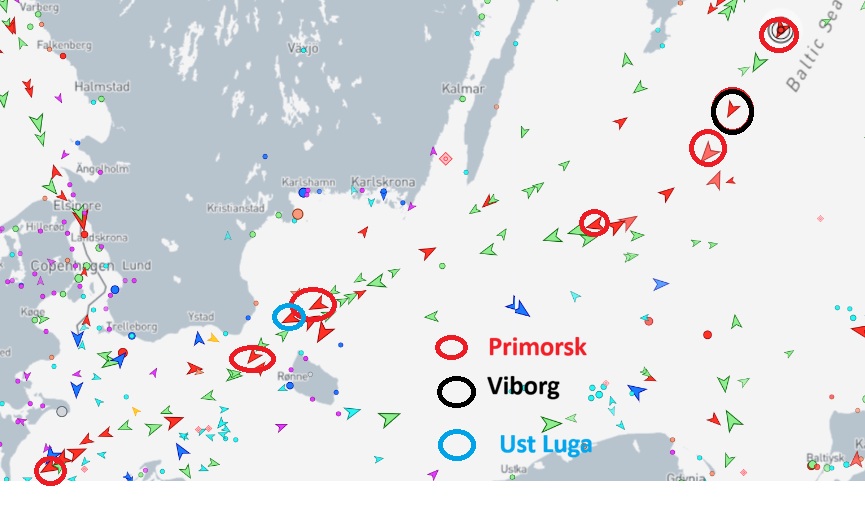
Tougher coast guard
The Nordic and international response has forced new routes for the few ships that manage to load. Due to tightened British and EU controls on the shadow fleet in the North Sea and English Channel, Russian tankers from Primorsk have started to go north of Scotland. This extends the journey by about two days.
Another example: Coast Guard raid on tanker Sea Owl off the Swedish south coast on March 15. The ship, without cargo, was en route from Brazil to Primorsk. The operation was carried out with a police helicopter and boarding boats in Swedish territorial waters. The authorities suspected that the ship was sailing under a false flag. False documents were found registered in the Comoros . Sea Owl together with the bulk carrier anchored off Trelleborg. A similar raid on tanker Flora 1 has not led to detention because Cameroon’s flag status could be confirmed.
Identified ships
| Ship | Event | Datum | Details |
| Flora 1 | Departure / Boarding | 1–3 april | Left Primorsk on April 1st , bound for Santos, Brazil. Boarded by the Swedish Coast Guard off Ystad on April 3rd after a suspected oil spill off Gotland. The vessel belongs to the Russian shadow fleet (Cameroon/Sierra Leone flag). |
| Aframax Jewel | Redirection | 4 april | While Primorsk was idle, this ship was reported to be the first to resume loading in the neighboring port of Ust-Luga on April 4. |
| Unidentified tankers | Anchored | 1–7 april | MarineTraffic shows a buildup of waiting ships in the eastern Gulf of Finland that cannot be brought into berth due to the security situation following the attacks on April 5. |
Timeline: Oil War March–April 2026
Mid-March: Increased control of the shadow fleet
- March 15: The Swedish Coast Guard carries out a dramatic raid on the tanker Sea Owl off the south coast. Boarding is carried out by helicopter and boats on Swedish territory. The ship is suspected of sailing under a false flag (Comoros) and is being held for investigation.
End of March: Initial attacks and export decline
- Week before April 1: Exports begin to decline. The number of departures from Primorsk falls from the normal 10 ships per week to only 4 due to previous drone strikes in March.
- Logistics: Russian oil companies are being pressured to install ”anti-drone towers” and protective nets around critical valves as a desperate defense.
Early April: Escalation and chaos
- April 1: The tanker Flora 1 (the shadow fleet) leaves Primorsk with destination Brazil.
- April 3: Flora 1 is boarded by the Swedish Coast Guard outside Ystad after a suspected oil spill off Gotland, but is later allowed to continue when flag status (Cameroon) can be confirmed.
- April 4: While Primorsk is at a standstill, the Russians are trying to redirect traffic. The tanker Aframax Jewel is reported to be the first ship to resume loading in the neighboring port of Ust-Luga.
April 5: The Great Drone Attack
- Night of April 5: Ukraine’s Unmanned Systems Forces conduct a massive coordinated attack with 87 drones. 19 drones strike Primorsk.
- Direct effects: Fuel tanks (cisterns) catch fire. Loading is immediately interrupted. Black smoke plumes are visible as far as Finland.
- Flight disruptions: Pulkovo Airport in St. Petersburg is closed. Flight routes over northern Europe are being rerouted due to Russian air defense activity.
- Port status: Piers 2 and 4 are on fire. No new tankers are allowed to dock at the terminals.
April 6: The terminal is operational.
- Chaos in the port: Primorsk is reported to be essentially completely out of service. Ships that were at the quay are being forced out to the roadstead for safety reasons while firefighting is underway.
- Market impact: Uncertainty in the world market is rising. Analyses show that Russian exporters are losing almost $1 billion in revenue in just one week.
April 7: Injury and paralysis
- Status Primorsk: Only one of three landing stages (Pier 3) is functioning properly. Half of the storage capacity is out of service. Tanks are leaking oil and the pumping systems are damaged.
- Status Ust-Luga: The port is closed for oil deliveries after fires. Only bulk goods (coal/fertilizer) are being shipped.
- Export collapse: Total Russian export capacity in the Baltic Sea is estimated to have fallen by 40%.
- Blackout: Marine Traffic reports that Russian captains are increasingly turning off their AIS (position sensors) to avoid being targeted. Russian ships are being forced to take expensive detours north of Scotland to avoid EU control.
Summary of identified vessels (April 1–7)
| Ship | Event | Details |
| Sea Owl | Seized | Boarded March 15; false documents; detained in Trelleborg. |
| Flora 1 | Boarded/Released | Suspected oil spill April 3; belongs to the Russian shadow fleet. |
| Aframax Jewel | Redirected | Tried to load in Ust-Luga on April 4 when Primorsk was crippled. |
| Unidentified | Anchored on the shelter | At least six ships from the shadow fleet are waiting in the eastern Gulf of Finland without the possibility of loading. |
/ By Ingemar Lindmark