

The villages in Bohuslän and Västergötland are one of Europe’s most war-torn areas. In the ethnic cleansing, it was a question of looting and murder to prevent the opponent, who was happy to advance just as hard. For 200 years, the landscapes were used as battlefields and food stores.
google-site-verification: google4bea300b7401f472.html

/ Ingemar Lindmark ♦= click to maps
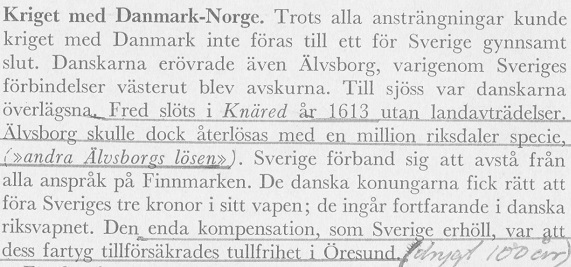
The clips are taken from Swedish History for high school from the 1960s. Not a word does the dry textbook Swedish reveal that the Kalmar War was the cruelest we have ever had on Scandinavian soil. Farms and towns were burned in the landscapes on both sides of the border between Sweden and Norway/Denmark.
The horrors of the war have been and still are hidden from Swedish schoolchildren. If the hero kings of the history books had wreaked havoc today, they would have been sentenced to life imprisonment in the Hague Tribunal.
The Kalmar War is called the Burning War in the regions on both sides of the Göta River, because both the enemy and their own people applied scorched earth tactics. Barns and inns were emptied by armies larger than before. The need became great and people starved, no one knows how many died. There were many widows. Many women were supposedly defiled by the knights. More died of field disease than in battle. They were housed in the cabins and spread the infection to the local population.
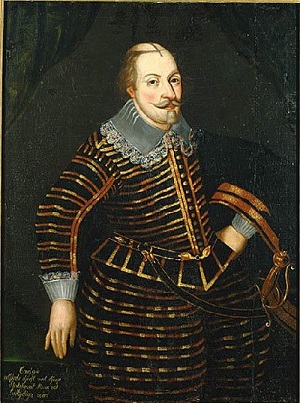
Swedish trade at the mouth of the river in what would become Gothenburg was a thorn in the side of the Danish king Christian IV. Öresund, guarded from the fortresses in Helsingör and Helsingborg, put a lock on the Baltic Sea, not to mention that Swedish goods on Swedish keel were exempt from paying customs duties.
Shipping from Russia to Western Europe increasingly took the route from Arkhangelsk ♦ past the North Sea, which both Christian and Charles IX – “King of the Lapps” – wanted to access. The Swedish king put his own lock on Russian Baltic Sea traffic with Estonia and conquests near Ladoga. Swedish troops were ravaging there and then the Danes took advantage. The war that ended with the Älvsborg ransom was Denmark’s last victory, because then Sweden took over the role of great power.
Bail
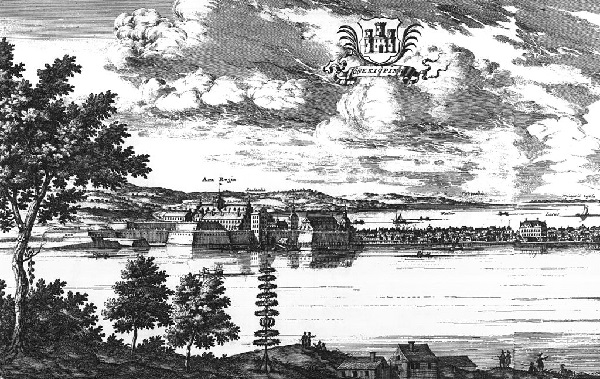
Old Älvsborg ♦ is visible today only as remains of walls on the cliff just east of the southern bastion of the Älvsborg Bridge. The castle and fortifications were demolished after the Peace of Roskilde in 1658 and New Älvsborg was built in its place on an islet further out in the fjord.
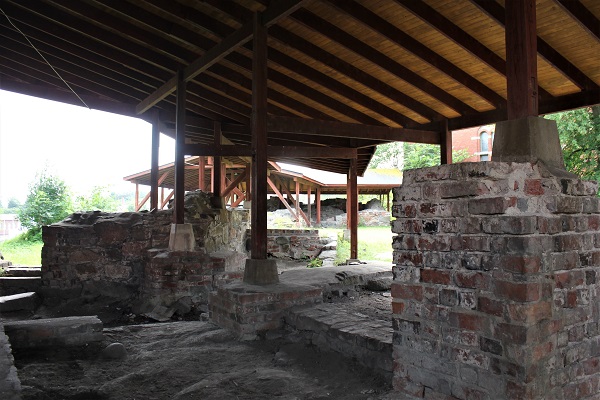
A medieval wooden castle burned down. Gustav Vasa built a typical Vasa castle with three round towers, like an Italian castle. Despite the stone and brick in the walls, the fortification became hopelessly outdated to withstand the new cannons of the time.

For those visiting the site today, the view to the north is obscured by the Carnegie Brewery, which has been converted into a hotel. To the south, Billinghöjderna ♦ at Nya varvet ♦ is hidden by a castle-like building that used to be a sugar mill. Kärringberget and the Nya Älvsborg fortress ♦ further out are also not visible.
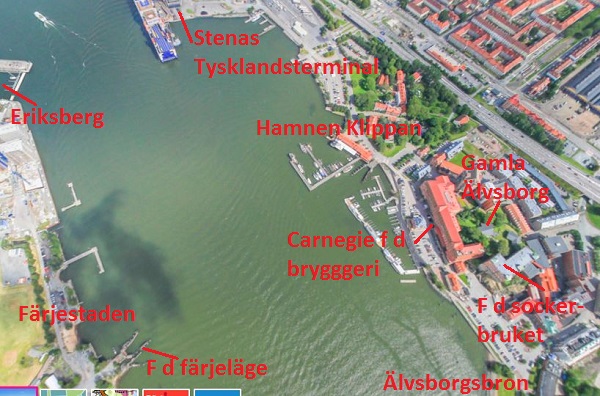
Let’s use a drone to help us live in the landscape in January 1611, the month when Christian IV at a drinking party in Bergen ♦ decided on war against Sweden. For two years now, several hundred farmers have been forced to do day labor to improve the weak outworks outside Älvsborg Castle ♦ . All according to Dutch fortification art. The moat is poorly dug and easy to force.
Oxen pull sledges of stone from boats and quarries. Smoke billows from the brickworks. The sawmill at Mölndalsfallen is busy processing timber. The almost 400-meter-long embankment that protects shipyards and ships is being improved. At the far end, at today’s Stena Terminal, Klippan ♦ is being fortified . At that time it was called Skinnarklippan, because since the Middle Ages oxen had been important in collecting taxes. They made their way to the butchers on the mountain on their own hooves. The tanneries gave the place its name and contributed to the country getting much-needed export currency. Some years Falun had to do without oxen, as raw material for sausages and ropes in the copper mine.
The port of Klippan was already important in the Middle Ages because further inland the river was too shallow for cogs and sloops. Now several of the crown’s ships seek shelter here, prevented from reaching the Skagerak by the Danish king’s fleet.
Hisingen
Let the drone look north. The green area between Älvsborgsbron and Eriksbergsdock with the gantry crane was filled in 1611 with Dutch people in Charles IX’s city, named after its founding in 1603. The place is better known as Färjenäs ♦ after the boats that went from here to Klippan until 1967. The ferry docks are still there. The name Gothenburg was coined with the city privileges in 1607 when construction began under master builder Hans Flemming. Both he and the king have had streets named after them.
Charles IX visited the city in 1609 when coins were minted there under the Dutch mayor Abraham Cabeliau . His travels to the East Indies and South America were a merit in connection with the king’s plan for Gothenburg. Young Gustaf Adolf’s mistress, Cabeliau’s daughter Margareta, had a child, named Gustav Gustavsson. In 1638 Cabeliau was responsible for the founding of New Sweden in Delaware.
Dutch and other foreign-born people were attracted with reduced customs duties and 20 years of tax exemption. It is not known how many of the 200 houses were actually built. A wooden church for the Lutherans was erected. Remains of the church that was built for it are still visible ♦ . It is unclear whether it was Reformed or Lutheran.

The planned moat and city wall were not completed in time, probably because more conscripted peasants were needed to reinforce the castles of Älvsborg and also Gullberg.
For Charles IX it was about trade policy. Sweden was isolated, not unlike the encirclement during the Second World War. Admittedly with the river mouth as an opening to the North Sea, but the Danish fleet blocked it. About thirty Danish warships patrolled the Baltic Sea with Ösel and Gotland as support points. Skåne and Halland were Danish provinces. Likewise Bohuslän in Norway, which stretched along the Atlantic up to Finnmark, where Charles IX irritated with remainsadvances up to the Arctic Ocean. The Lapps with their wandering herds were forced to pay taxes in two countries, between which there was no clear border.
The Netherlands was the leading shipping nation and their bankers could provide loans to pay for mercenaries. Dutch and other foreign-born people were attracted to the new city of Gothenburg with reduced tariffs and 20 years of tax exemption. They seem to have started the export of copper and agricultural products, a competition that worried Christian IV. Who was further irritated by the fact that Dutch people under the Swedish flag of convenience could sail duty-free through the Sound. And by the fishing rights they received in Northern Norway. However, the Swedish king’s plan to transport Russian goods overland from Lake Mälaren to Gothenburg remained a dream. The lock in Lilla Edet, completed in 1607, and Charles IX’s canal can be seen as part of an effort to reach the Western Sea.
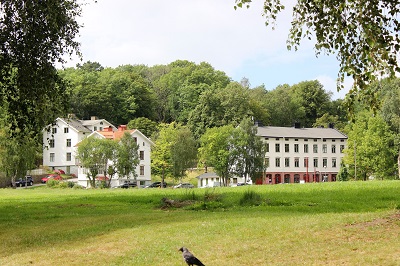
The southern river channels were too shallow for larger ships. From the sea they could not get further inland than to Klippan – and to Charles IX’s city as long as it existed.
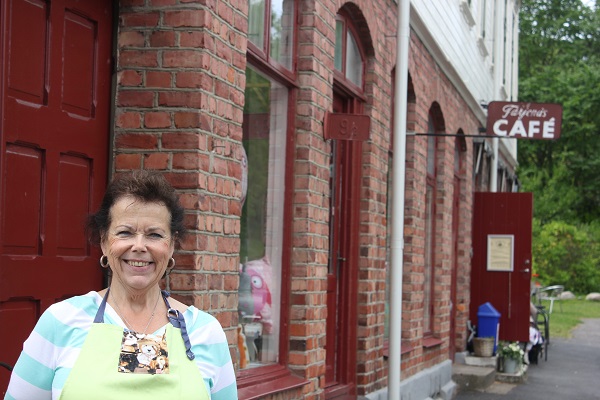
Only a few houses remain after the major demolition to expand the Eriksberg shipyard. The 1980s crisis killed the shipyard and Färjestaden became a leafy park instead. The over a hundred-year-old café ♦ still remains.
.
The breathing hole to the west
Around 1250, Earl Birger Magnusson met with Håkonsson to conspire against a Denmark that was obstructing shipping in the Baltic Sea. As a reward for the intrigue, Sweden received the Vättle and Sävedalen counties from the Norwegians. The corridor to the North Sea was later expanded with the Askim county, which meant a national border just south of today’s Ikea in Kållered.
Gullbergs hed ♦ (or Ed, for transshipment site; today the Gamlestaden district)) at the mouth of the Säveån River in the Göta River was a popular meeting place for the kings and their accompanying armies. Birger Jarl’s grandson, King Birger Magnusson, built redoubts on Gullbergsklippan in the early 14th century; probably caused by the conflict with his brother Erik who ruled on Ragnhildsholmen ♦ at Kungahälla, in a mini-kingdom with southern Bohuslän, northern Halland and Lödöse).
With Ingeborg, daughter of Norwegian King Håkon Magnusson, Erik had his son Magnus Eriksson, who often visited the castle of Lindholmen ♦ , which was part of the morning gift to Queen Bianca of Namur. The castle was located (until the beginning of the 15th century) on Slottsberget, next to the now defunct Lindholmen shipyard basin.
When in 1308 there was a dispute between Erik and his father-in-law Håkon Håkonsson Hålägg (grandson of Håkon Håkonsson who donated the Hising parishes of Lundby ♦ and Tuve ♦ to the Swedes), Hålägg had Bagaholmen fortified into what would become the fortress of Bohus Slott. There, at the western and eastern branch of the Göta River, tolls were collected, which may have contributed to the town of Lödöse ♦ being moved to Nya Lödöse ♦ at the end of the 15th century and then under Gustav Vasa. In our time, the Old Town with the Skansen Lejonet on Gullbergsklippan ♦ , not far from the southern mouth of the E6 tunnel.
In 1563, during Erik XIV’s Nordic Seven Years’ War, Frederick II’s troops burned Nya Lödöse. The force, mainly German mercenaries, laid siege to Elfsborg ♦ 22 August. After the capitulation two weeks later, the Danish flag was seen in the tower. The fact that the farmers on both sides of the border had agreed not to attack each other did not prevent the armies from burning and destroying wherever they advanced. All according to Erik XIV’s orders to his military commander: ”Spare no one, but plunder, burn, kill, leaving the people free to plunder and plunder”. The Swedes burned Hisingen and Uddevalla, with surrounding villages, in the summer of 1564.

The clash of arms before the war
A Swedish army under Jacob de la Gardie ravaged Novgorod ♦ and occupied Moscow for three months. Charles IX, who was babbling after the stroke, managed to get the parliament in Örebro to decide in December on the mobilization of Swedish small farmers combined with the conscription of knights from the other three estates. With hesitation, the king was known as an unsuccessful military leader.
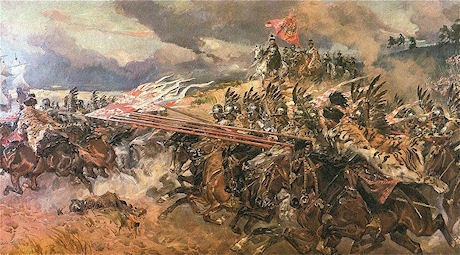
The worst was the battle in Kirkholm ♦ outside Riga when 3600 Polish horsemen mowed down 9000 Swedish soldiers. In terms of deaths, a worse defeat than in Poltava. No other battle in Swedish history shows a greater loss of life, something that school history books would rather forget.

During wild celebrations in Bergen on New Year’s Eve 1611, Christian IV declared war on Sweden. The Danish royal council had long curbed the king’s warlike spirit. The council relented on a February day when Christian threatened to start a war on his own initiative as Duke of Holstein.
At Elfsborg, Danish war preparations were noticed early on. Cannons and supplies were bunkered at Bohus Fortress. The county lord Steen Matsson Laxman was ordered to mobilize 2,000 peasants. The peasants and their sons fled to the forest when the crown’s conscripts appeared in the area. Those who were recruited were unused to war and often escaped. Just as in 1563, they were not willing to fight against their neighbors on the other side of the border. They were used to exchanging goods with each other. As when King Christian forbade the citizens of Uddevalla to exchange salt for agricultural goods. Grain was in short supply in Norway.
How people hid in more or less devastated forests east of Ljungskile is illustrated in Bredfjällsspelen .

Kristian therefore had to rely largely on foreign mercenaries, effective in battle but unreliable when they were hungry and did not receive their pay. The seafaring people of Bohuslän hid when Captain Isac Måneskiöld from Sundsby ♦ on Tjörn forced boatswains into the fleet.
Isac Måneskjold later ended up in Dragsholm’s ♦ prison tower on Zealand, caused by wife abuse and a peasant uprising in Grohed ♦ south of Uddevalla.
The Naval War of 1611
Charles IX receives the Danish declaration of war in April. Eight Danish warships
among the archipelago islands outside Vinga block supplies to Elfsborg. They are led by Admiral Jörgen Daa on the frigate Heringnäs. His second-in-command, Captain Jens Munk, takes command of the small ship Den Sorte Hund. They will play the main role in the Danish ravages.
On the night of May 24, the Swedish ships attempt a breakout. The largest are Hector and Blå Ormen with 28 cannons each. They are seconded by the frigates Krabban, Jonas and Fransiska. Munk mostly attaches himself to a small sailing yacht, named Lamprenen after a sucker fish. Thanks to the current and good wind, the Swedes get a good shooting position. When the wind changes, the Swedish boats go to the harbor. Shortly after, Munk hijacks a Dutchman with supplies for Elfsborg.
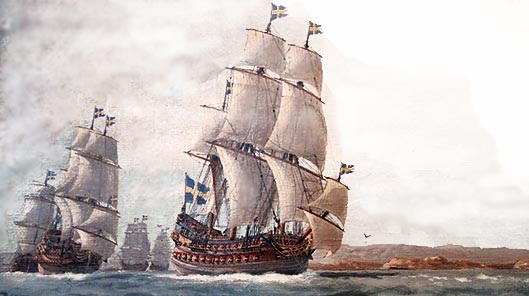
On July 12, Munk leads a force that burns down the town of Hisingstaden in Gothenburg for good. The feat is rewarded with the title of captain of Den Sorte Hund.
King Christian sets out from Kristianopel ♦ in Blekinge and besieges Kalmar in May. The commandant Christer Somme at Kalmar Castle ♦ surrenders. The bloodbath of Kalmar’s population is rewarded by the sixteen-year-old Crown Prince Gustav Adolf by massacring the people of Kristianopel.
A troop from Bohus Fortress ravages Hisingstaden Gothenburg ♦ in May. The rest is burned by Jens Munk’s soldiers in the summer. The foreigners, mainly Dutch, managed to escape with their ships – which, however, are plundered by the Danes at sea. After a period of imprisonment, the destitute are sent to their homelands.

Jens Munk attacks Älvsborg during the summer as a reconnaissance and then attacks Nya Lödöse. Despite his thirty years, he is an experienced but ruined seafarer after expeditions in the Arctic Ocean. After growing up in Fredrikstad ♦ northwest of Strömstad, the ship’s boy Jens was captured by pirates and managed to escape in Brazil. Once home, he was disinherited after his father Erik Munk of Halland, who hanged himself in the Dragsholm prison tower . Despite losing his noble title, he became a war hero in the Nordic Seven Years’ War but fell out of favor as a harsh county lord. Jens Munk wanted to be knighted through feats, which in 1619 led him to lead an unsuccessful expedition to find a northwest passage to Asia from Hudson Bay.
A Danish force burns farms and villages up in Västergötland without encountering resistance because the Swedish troops are busy around Kalmar. Until, in the devastation of Skara ♦ they are chased to Bohuslän by a Västergötland company with horsemen and peasants.
In October, Charles IX dies at Nyköping Castle. In the same month, diplomat Olof Stråle becomes governor of Elfsborg. Despite his meager military experience, he realizes that the fortifications at the river mouth are not much of a defense. For cannons mounted on the surrounding mountains, the walls are an easy match.
The Danish squadron was initially too small to attack Elfsborg. The ships were needed more in the Baltic Sea. But in November Admiral Daa received reinforcements with the frigate Victor armed with forty-four guns. Sixteen small landing craft came from Bohuslän.

Protected by Victor and Heringnäs, Jens Munk’s landing craft rowed towards the quays in Klippan ♦ on the night of 27 November. Burning tar thrown out by the Swedish crew did not help. The Danes, probably mostly Norwegian Bohusläningers, boarded the frigate Hector so that the Swedish sailors had to flee to the fortress.
A fireboat with wood shavings and tar plugs set Hector on fire. Jens Munk and his men on deck fanned the flames. Eighteen fell victim to bullets fired from the harbor rampart. In the retreat, Munk saw how the entire Elfsborg fleet was on fire. The Swedes later sank all the ships in the harbor so that they would not fall into the hands of the Danes.
During 1611, the Danish navy had halved the Swedish naval tonnage in battles off Gothenburg and Kalmar. In November, a desperate Gustavus Adolphus sent a request to his representative in England to have 3,000 mercenaries drafted, with delivery to Älvsborg after the ice broke in April. The result was a few hundred, most of them recruited from vagrants and prisons in Scotland. The king had better luck with the Dutch mercenaries, even though they arrived after the fall of Älvsborg.
Winter 1612
At Lucia, the Danish squadron weighed anchor to spend the winter in Öresund. Kristian rejects Gustav Adolf’s peace offer at Christmas time. At that time, the ice settled in Öresund and after a hard winter, it did not loosen until March.
Gustav Adolf had just turned seventeen and would not become of age as regent until he was 24 years old. Sigismund of Poland claimed the throne and his uncle Johan was the rightful heir to the throne. And now Christian IV who wanted to revive the Kalmar Union. The guardians were shaken and therefore the Estates declared Gustav Adolf to be in power on Boxing Day. This was conditional on a royal declaration that expanded the privileges of the nobility, especially when the Reichsrat under Chancellor Axel Oxenstierna . Then a ruthless war criminal, later architect of a state apparatus that made the country a great power.
It was an unusually harsh and long winter. The fleet was frozen, but movement on land was facilitated by sledges and transport on frozen waterways. The problem was to feed the troops, which required constant movement in the poorer areas, preferably in enemy territory. A 10,000-man army required 3,000 liters of beer, 8 tons of bread, meat from 40 oxen and fifteen tons of horse feed every day. They left behind empty barns and guest houses, if they even existed. If the houses were not burned as firewood, they were burned as pure terror. Fire taxes and death threats were common to force the production of hidden assets.
After New Year’s . King Christian leaves Varberg ♦ with 2,500 soldiers. At about the same time, a Danish army led by Gert Rantzau enters Småland. Seventeen-year-old Gustav Adolf retaliates by wreaking havoc in Skåne.
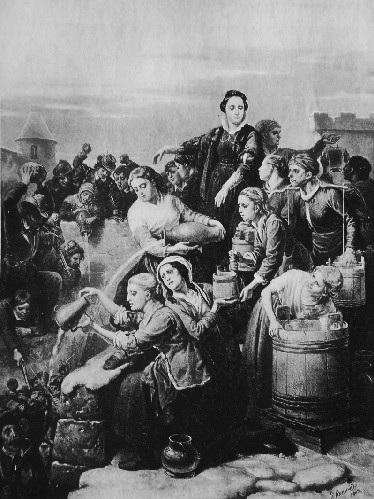
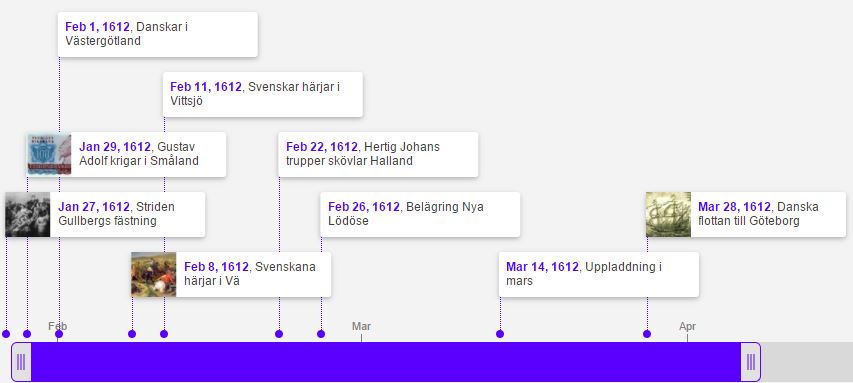
January 27. During the night, Kristian attacks Gullberg’s fortress with 2,000 men ♦ . The gate is blown up and in the fierce battle that follows inside the castle, the commandant Mårten Krakow falls off his horse and breaks his leg. His wife Emerentia Pauli ensures that the castle’s knights’ wives boil lye in large cauldrons. They then throw the liquid over the enemy when they emerge from the ramparts to blow up their pertards. They also pull out stones as protection for their own soldiers who shoot the Danes on their way up the storm ladders. After five storms in five hours and 200 soldiers lost, the Danes retreated. Instead, they invade the town of Nya Lödöse at the mouth of the Säveån River.
January 29. Seventeen-year-old Gustav Adolf leaves the Ryssby ♦ stronghold outside Kalmar with 3,000 soldiers and marches via Växjö into Skåne . Without military resistance, the Danes are busy killing people in Småland and Västergötland. Scorched earth tactics are applied in twenty-four Skåne parishes. “We have ravaged, destroyed, burned and killed completely according to our own will,” writes the king.
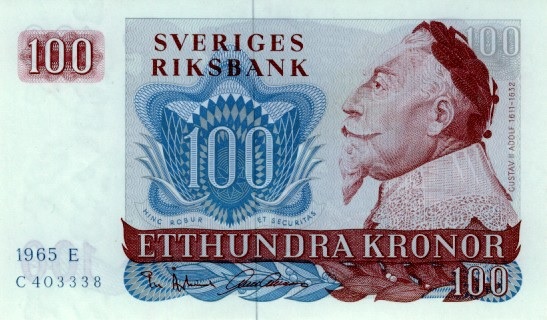
February 1. The Danish army is in old Lödöse and continues towards Skara, which apart from the cathedral is set on fire. They meet no resistance and ravage an area as large as Bohuslän and Dalsland combined. Instead of meeting in clashes, the armies prefer to terrorize the common people with exploitation and burning.

February 8. Kristianstad’s predecessor Vä ♦ is burned down. Gustav II Adolf is said to have seized the church bells and communion silver.
February 11. “And the Swedes had their horses in the church, and had broken the chairs, and burned them.” Danish propaganda does not miss the fact that Gustavus Adolphus’s knights set fire to the benches of Vittsjö ♦ church and then stabled the horses in the temple. The following night, 300 German and Danish horsemen surprise the bivouac with 1,400 Swedes. 300 of these fall and the king is rescued from a wake.
February 22. An army under Duke Johan of Östergötland attacks Halland on the king’s orders. There the soldiers ravage eighteen parishes in Viskandalen down to Varberg. On Kölleryds ♦ heath they surprise Christian forces that have retreated from the devastation of Västergötland. 300 Danes fall but King Christian escapes. Field Colonel Jesper Mattson Krus continues north.
February 26. Swedish troops under Jesper Cruus besiege the Danish-occupied Nya Lödöse during the night. After cannon fire from Älvsborg, a trumpet signal is heard. After negotiations, 500 Danish knights are granted free passage, some mercenaries even go over to the Swedes. 300 Norwegian peasant soldiers are not included in the capitulation, but are cut down to the last man. Then the town is burned, even though it is actually Swedish. Many became widows in Bohuslän that night, one can assume.
March. Jesper Krus takes over the troops to Hisingen where they rape and burn almost all the farms. The city of Kungälv ♦ is set on fire but the fortresses of Bohus and Marstrand are not ventured. Nor are any attempts made from there to hinder the advance of the Swedes. The fear of military confrontation may be related to the low morale.
450 farms in the districts up to Uddevalla are destroyed by fire. The city is burned in March and the devastation continues northwards in the countryside. The war is called the Burning Feud here because, not counting Hisingen, 600 of 3,000 farms in Bohuslän were burned, resulting in great suffering for the survivors.
In March . With the thawing of the ice, the war marches cease. March 14 Gustav Adolf returns to Stockholm and the funeral of his father. Christian IV is in Copenhagen where he buries his queen Anna Catherine of Brandenburg.
Young Gustav Adolf responded by killing and burning in the same way in northern Skåne. Those who lived in the market town of Vä had to move to the new fortress town of Kristianstad ♦ .
Älvsborg is stormed
In March, a reinforced Danish fleet is back in the Göta River with Jörgen Daa and Jens Munk as commanders. There, the commander Olof Stråle must defend himself with 400 more or less combat-ready men against 20-30 times as many enemies. His fire-damaged ships are sunk in Klippan harbor. The sea route to the west is blocked. The hope that Gustav Adolf and his people will come to the rescue is not fulfilled because the king is busy murdering and burning farms in northern Skåne.
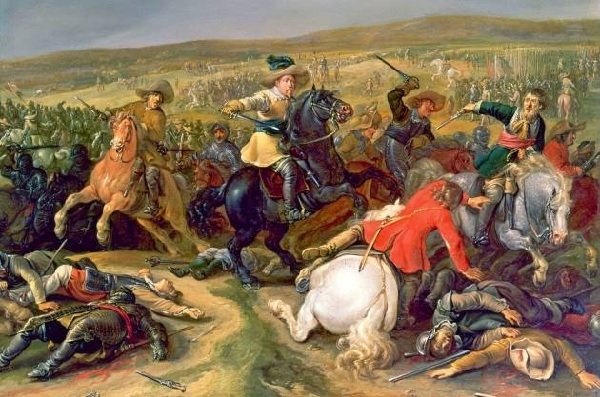
King Christian mobilizes in the spring the largest army that has ever attacked Sweden, a full 21,000 men. 8,000 in the eastern army are expected to set out from Kalmar under Field Marshal Gert Rantzau. Christian has 10,000 under him to take the river mouth with Älvsborg. Then the idea is that the two armies will meet in Jönköping to give Stockholm the coup de grace.
On April 24, Älvsborg is surrounded by Kristian’s soldiers. The ships land cannons, some taken from Bohus Fortress.
Early in May . The Danish-Norwegian captain Jens Munk knows the terrain well since last year. From the ship Sorte Hund he lands with 200 men and secures Kärringberget ♦ at the mouth of the river. After a hard battle, Billingen ♦ (at present-day Nya Varvet) is also taken. The ships from Helsingør are able to pass and land 5,000 near the fortress. They are joined by 2,000 infantrymen and the same number of horsemen who have come overland through Halland. They are led by the ambitious nobleman Jörgen Lunge, who has recruited a large number of mercenaries in Germany.
May 4. The Danish fleet from Helsingør with King Christian on Victor sails up the river. 5,000 are landed. The siege begins.
May 5-8. The emptying of the moat is complete. The King inspects the preparations from a small ship that is going up the Göta River. Sailors and soldiers block traffic from Gullberg Castle ♦ . They build a redoubt in Mölndal as an obstacle to Swedish help from the south.
With the reinforcements from Bohus, all in all, 10,300 under the Danish flag. According to other sources, 20,000, largely war-experienced mercenaries. Against them, they have 400 men and, as they say, 10 gunners at Älvsborg. Many are in poor condition. Despite that, the commander Olof Stråle does not intend to give up, as in Kalmar. There is plenty of ammunition for a dozen copper cannons and some iron ones. Stråle, with his meager military qualifications, has admittedly been fired as commander, but his replacement, Nils Stiernsköld, has not had time to get there.

On May 10 , 14 powerful cannons brought from Bohus are in place and bullets begin to hit the walls. Fire from Älvsborg kills some attackers and two assaults are repelled.
May 13. The Danes capture the outer fortifications at Skinnareklippan (today Klippan). There, the cannons are brought into close range of Älvsborg’s fragile walls.
May 15. King Kristian offers surrender with free retreat. Stråle’s request for a two-week pause is rejected. On the same day, Stråle is wounded when a fire breaks out in a wooden tower.
May 17. The battle intensifies, supported by fire from Danish ships in the harbor. Jens Munk and hand commandos dig tunnels so they can detonate mines in the wall at the moat.
May 22. Major attack. A massive shelling breaks a breach in the wall. In the first wave, English mercenaries attack from three directions but are beaten back in the collapse of the wall by boiling water and burning pitch. With their clothes in flames, they retreat between their dead comrades. The same fate meets the German knights that Jörgen Lunge throws. Then Kristian sends in his life regiment, trained in close combat, but they are buried by the eastern tower, which collapses when Commandant Stråle sets it on fire. Kristian lets the cannons rest during the evening and gives Stråle two hours to think about surrendering, which is refused.
May 24. The fact that the shots from the fortress have killed 200 of the attackers does not help. The fight is uneven for the crew of 400 men is half dead or wounded. Supplies are running low. The attackers penetrate a bastion and continue up a tower. Älvsborg is engulfed in gunpowder smoke and flames that turn large parts of the fortress into ruins.
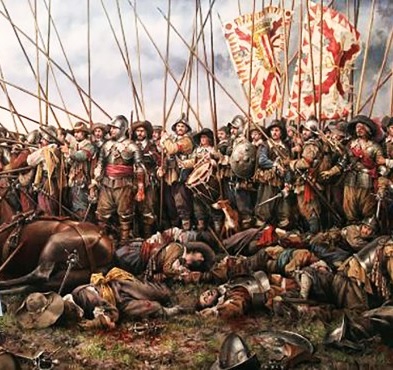
A final ultimatum to cut down the crew to the last man causes Olof Stråle to surrender, with a retreat under ”flying flags and ringing music”. Everyone, except a Danish deserter from the battle in Kalmar who is beaten to death at Billingen.
May 25. Jens Munk walks by Kristian’s side as he, along with courtiers and the highest officers, march into the fortress. A triumph for the adventurer Munk, who had been sent to slavery in Brazil by pirates two decades earlier . And half a century after his father Erik Munk became a war hero in the Nordic Seven Years’ War.
Scorched Earth
The border fortresses of Kalmar and Älvsborg with 40 cannons have been captured. Together with strong Bohus in the river branch, Kristian holds Sweden in an iron grip. Admiral Jörgen Daa has already set out on a pirate hunt with three Danish ships and has handed over command of the rest of the squadron to Munk.
June 1612. Jens Munk begins the salvage of the six Swedish ships in Klippan’s harbor. The frigates Hector, Krabban, Jonas and Blå Ormen are made ready for sailing. And finally the small yacht Lamprenen, which will become Munk’s favorite from now on. The Danish fleet dominates the seas. Öland is recaptured on June 11. Swedish troops are withdrawn to Russia where they make conquests.
Munk sails with English mercenaries on galleys up the Göta River. Up at Lake Vänern, the plague strikes. Since they have no boats to return to Marstrand, they set up camp on the shore. Munk goes from tent to tent and sees soldiers die, and in mid-June he himself falls ill. In the last week of June he is in Älvsborg and beds down on Lamprenen for transport to his home in Copenhagen. The king saw to it that he was given medicine, but he did not receive any title of nobility.
After the capitulation of Elfsborg, Christian IV marches with his army towards Jönköping. The intention is to unite with Gert Rantzau’s troops from Kalmar and then march towards Stockholm. The forests and poverty are the country’s best defense. The villages are emptied of people and supplies. The houses have been burned down by the retreating Swedish military. The same fate befalls the eastern army from Kalmar. Peasant ambushes prevented the Danes from reaching Jönköping, with cannons that Christian needed.

July 23. The Swedes have burned down everything except the castle in Jönköping when the Danes arrive there. The inhabitants have fled to Visingsö. Without cannons, the storming fails. The city is later moved to the strip of land south of Lake Vättern.
July 26. In Tenhult ♦ one mile south of Jönköping, forester Michel Jönsson has gathered 500 farmers who have hidden in the forests with a messenger. A Danish cavalry company sent to track down the Kalmar army with siege artillery rides into an ambush in Rogberga parish ♦ .Michel’s home guard blocks the path with falling trees and fire from their guns. The rest are fought off with bows and scythes. A little later, King Christian leaves Jönköping. Attacks and lack of food break his troops, especially the poorly paid mercenaries. The march towards Stockholm is interrupted.
August.
After the failure in Jönköping, King Christian hurried to Copenhagen, from where he sailed towards Stockholm with a force of men on 34 ships. 8,000 men were recruited in Kalmar.
On August 3, the Danes encountered surprisingly fierce resistance outside Vaxholm ♦ , largely thanks to 1,200 Dutch mercenaries. Their refusal to take up arms and to go from the invasion of Norway to Värmland and Västergötland and instead head for Stockholm probably contributed to the salvation of Stockholm. There, Älvsborg’s commandant Olof Stråle sits in a cell awaiting interrogation.
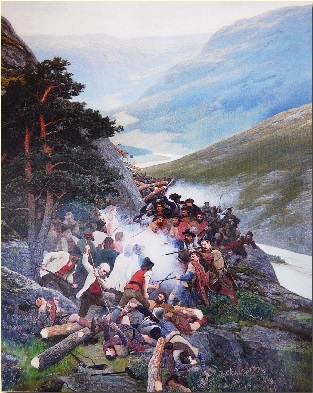
August 26. The Scottish mercenary army intended for Sweden lands in the Norwegian Westlandet. A force marches through Gudbrandsdalen preceded by the reputation as murderers and womanizers. In Kringen ♦ they end up in an ambush on August 26. 600 mountain farmers armed with axes, scythes and crossbows cut down most of the 300 Scots and the rest are killed in prison. Most of the army manages to get to Sweden but by then peace negotiations are already underway.
Kneeling
An estimated 3,000 Scots fought for Gustav II Adolf, while another 4,000 Englishmen fought under Christian IV. Although many Scots fought beyond the Baltic Sea, for James VI / James I it meant a kind of civil war on foreign soil, perhaps with a future continuation in a fragile Britain. The king of England and Scotland is married to the Danish princess Anne and is thus brother-in-law to Christian IV. After the wedding in Oslo, the couple traveled through Bohuslän and Halland to Copenhagen.
The royal alliance between Denmark and England is complicated by James backing Sweden in the war against Poland and Lithuania. Access to the Baltic ports through the Sound and also to Gothenburg is important for the English. James therefore begins diplomatic activity in Denmark and Sweden, both of which are impoverished by the wars. Burnt parts of the country cannot afford to pay taxes and, especially in Denmark, the mercenary troops have emptied the treasury.
The peace efforts begin with Jacob IV sending the Scotsman Jacob Spens to Gustav II Adolf and his stepbrother Robert Anstruther to Christian IV during the summer. They manage to get the two kings to exchange letters which in turn lead to peace negotiations at a border stream near Knäred ♦ a couple of miles east of Laholm. More precisely in a village on the Lagastigen called Sjöared ♦ on the Halland side and Sjöaryd on the Småland side.
The correspondence between Christian IV and Gustaf II Adolf replaced the diplomatic prelude. The Danish king was in Halmstad and held the best cards. The winter peace negotiations in Knäred in Halland, near the Småland border, resulted in the peace settlement on 20 January 1613.
No land cessions but one million silver coins delivered within six years to redeem the Göta River mouth with Älvsborg Castle. A quid or double, because otherwise Denmark will also keep the installment payments.
/ By Ingemar Lindmark