


Jens Munk’s Hudson Bay Expedition (1619–1620)
In 1619, the Danish-Norwegian navigator Jens Munk led an expedition sent by King Christian IV, with the goal of finding the Northwest Passage – a sea route north of North America that would open a fast trade route to Asia. The expedition consisted of two ships, the Enhiörningen and the Lamprenen , and sailed via Greenland into Hudson Bay.
Munk and his crew overwintered at the mouth of the Churchill River. The Arctic winter, lack of fresh food and scurvy drastically decimated the crew. Out of 64 men, only three survived: Jens Munk himself and two of his men.
In the spring of 1620, the three survivors managed to get the Lamprenen ready to sail and return to Norway on their own. The expedition was thus a dramatic failure in terms of finding the Northwest Passage, but Jens Munk’s journey is still considered one of the most significant and enduring polar historical feats in Scandinavia.
Swedes?
Jens Munk almost a Bohusläning? The Skagerak archipelago has been a breeding ground for a number of long-distance adventurers. Jens Munk grew up in Fredrikstad ♦ , possibly in Hvaler (near Strömstad where his mother was buried at Hvaler church). Roald Amundsen ♦ , who in 1903 with the ship Göa became the first to pass through the Northwest Passage, was born one mile from Fredrikstad.
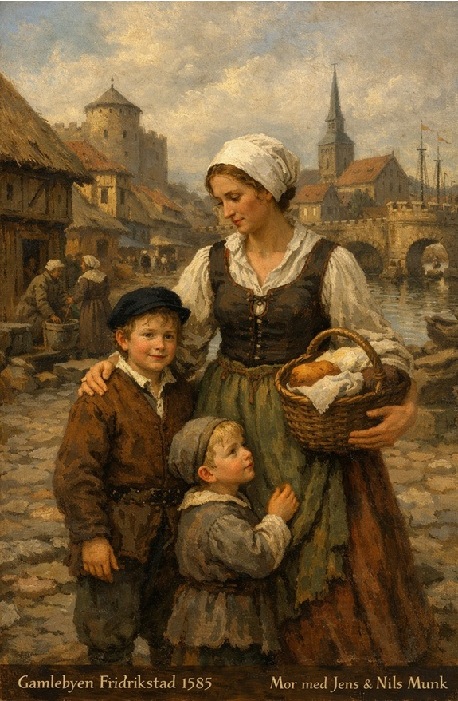
The year was 1620 and the place the mouth of the Churchill River ♦ in Hudson Bay.
” Easter Day fell on April 16. Anders Oroust and cooper Jens, had been ill and had been bedridden for a long time. They were buried the same day out on the tundra because the weather was mild .”
Not much is known about this Anders. Orust is a good guess and thus Bohusläning. Swedish according to today’s borders, but the province only became Swedish with the Peace of Roskilde in 1658.
Munk writes in his diary that in May Sven, Anders, Morten – all with the surname Marstrand – died. Marstrand is indeed a Danish surname. It is more likely that they came from Marstrand or the city’s surroundings. An area well known to Munk since his ravages in the Gothenburg area in Brännejden in 1610-1612.
It was then that he captured the sailing yacht Lamprenen (Limelight in Swedish) from the Swedes at the old Elvsborg fortress. This saved Munk and his two companions on their journey home to Norway and Denmark.
Who was Anders Oroust? Apparently the first Bohuslänningen to set foot on American soil. And in terms of modern geography, also the first Swede. All we know is this obituary in Jens Munk’s Navigatio Septentrionalis where he describes the failure to find a passage west to China and India. But let’s start with the beginning of the journey.
/ By Ingemar Lindmark ♦= click to map
Only Jens and four others had enough strength to listen to the sermon on Good Friday. 45 of the 65-man crew were already dead, suffering from scurvy. Fifteen more would perish before Jens and two others managed to free the sailing yacht Lamprenen and make it home to Norway in dangerous storms.
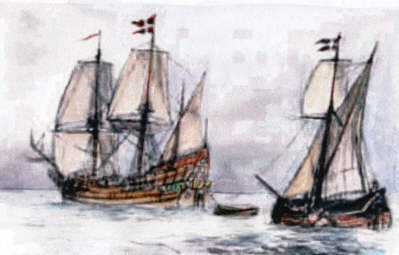
The Unicorn and the Lamprell. (Click to the image source)
Sea-going Bohuslän residents were certainly well placed to enlist for the frigate Enhörningen and the yacht Lamprenen . It was called Lamprellen in Swedish when Munk captured her at Älvsborg Fortress in 1612 ♦ .
Three who died in May had the surname Marstrand – Sven, Anders and Morten. There were certainly many who left southern Bohuslän after the Bränne Feud in 1612, badly damaged by the Swedish devastation. In 1630, Rolf from Marstrand became the province’s and indirectly Sweden’s first settler in America. Christian Jacobsen Drakenberg claimed to come from the Strömstad region and became a sailor on Danish warships.
The Skagerak archipelagos have been a breeding ground for a number of long-distance adventurers. Jens Munk grew up in Fredrikstad ♦ , possibly at Hvaler (near Strömstad where his mother is buried). Roald Amundsen ♦ was born a mile from Fredrikstad , who in 1903 became the first to pass through the Northwest Passage with the ship Göa. At the same time, the fur trapper Harry Macfie from Ljungskile ♦ panned gold in the Nelson River not far from Munk’s winter quarters. (Two 19th-century examples are the Jerusalem voyager Olof Henrik Larsson from Skaftö ♦ and Niklas Hedström from Orust , who was commander of the cannibal king’s fleet in Fiji).
Regardless of whether one or four Bohusläningers were first on the new continent, the journey is well worth following. The hardships were inhuman. The bodies of the three from Marstrand may have been eaten by polar bears. Anders Oroust’s grave may still be there if it has not been washed away by ice and waves.
May 9, 1619, Copenhagen
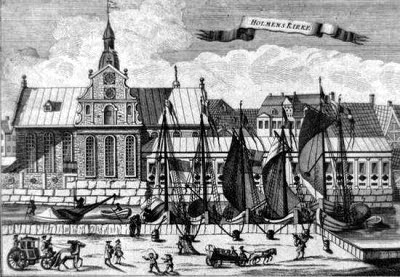
Holmen’s Church
The shipyard’s anchor forge has just been resurrected as Holmen’s Church ♦ . The church service on May 9, 1619 is unusual. King Christian IV has left Christansborg Castle ♦ on the other side of the canal and is giving a speech to an unusual audience: 61 sailors who will soon board the ships that intend to pass through the Northwest Passage – if it exists.
The king bares his head and calls down his blessing on the kneeling sailors. One by one they take an oath of allegiance before the expedition leader Jens Munk, Jan Olluffsen, skipper of the frigate Enhörningen, and Jens Hendrichsen, with the same position on the yacht Lamperellen.
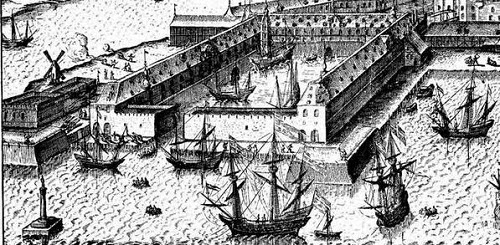
May is at its most beautiful when, after the ceremony, the sailors walk down to the ships that are ready to depart in Tøjhushavnen ♦ (Some of the fleet’s warehouses remain on Slotsholmen, but the basin has been filled in to make room for the Royal Library).
First, the standard bearer walks with the king’s naval flag that will be hoisted on the Unicorn’s mainmast. Munk’s wife Kathirine Adriansdatter and the four children have come down from their home on Pilestræde ♦ (the alley that today opens onto Ströget at Illum’s department store) and say a fond farewell on the quay.
“Entrar sempre deus de começar Vida Boa Vida”. That is the title of Munk’s travelogue, in Portuguese he learned as a prisoner of pirates in Brazil. The free translation “God always ensures that life is the beginning of a good life” is an apt motto for the man who never gives up. He is ruined and thrown out of the successful whaling business he started. Last year he was replaced by a nobleman who commanded the fleet the king sent to India. If he could find the shortcut that Hudson and several others had sought between the Atlantic and the Pacific, he would get his revenge – and the much-coveted title of nobility, the same one that was taken from his father Erik before he was imprisoned in the Dragsholm castle tower ♦ .

Jens Munk has had a busy few days since he received the king’s OK in March for the expedition that would explore a shipping route west to China. Henry Hudson had tried. The only result was to give names to the Hudson River and Hudson Bay. There in the south, Henry and his son disappeared in the ship’s boat after the crew mutinied and sailed home in 1611. Captain Thomas Button did indeed find no opening to the west when he sailed along the west side of the bay the following year. The two English navigators should have known that, but Munk hoped for a northwest passage after all.
Munk has to pay dearly to clean up the Englishmen Gordon and John Watson as navigators, experienced from the polar waters and perhaps also the entrance to Hudson Bay. Finding good seamen at the Bremerholm office ♦ was not easy for Munk, especially as the plague was ravaging the city. The best sailors had accompanied the six ships sent to India in 1618. Finally, he has 61 men on the roll, apart from the navigators and two German field marshals, all of whom are Danes and Norwegians. One is Anders Oroust from Orust. Perhaps Sven, Mårten and Anders Marstrand come from Marstrand.
Lots of people on the quays. Even the shackled convicts out on the ramparts cheer as rowboats pull the Unicorn and the Lamprell out to open water. No wind fills the sails so the departure is delayed. It is not until Whitsun, May 16, that the boats pass Kronborg Castle ♦ at Elsinore. Shortly afterwards, an unfortunate crew member jumps overboard, a suicide that some see as an omen.
June, across the Atlantic
On 25 May, the Lamprenen leaks off the southern tip of Norway. The carpenters have pitched three bolt holes but forgotten to put in the bolts. The boat was repaired off Haugesund ♦ where three young crewmen were recruited as compensation for the two men lost. On 30 May, the voyage continued past Shetland and the Faroe Islands until Greenland appeared on the horizon on 20 June.


Martin Frobisher
After much ice and fog, America is sighted on July 8. Not in Hudson Strait, but they sail into a bay to the north in Baffin Island. Because of all the ice, it is named Isfjord instead of the established Frobisher Bay ♦ . The Briton Martin Frobisher was both here and further into Hudson Strait in 1560. As proof that he had been to China, he brought home a kidnapped Eskimo.
Back at the mouth of Hudson Strait, the ships pass Resolution Island ♦ where a place is named Munkenes. Five-meter tidal range, currents and dangerous headwinds make navigation difficult. They manage to make their way westward into Hudson Strait and in the middle of July 17th they anchor at the Salvage Islands on the south coast of Baffin Island. The place is located about eighty miles south of the present-day Inuit community of Kimmirut ♦ .
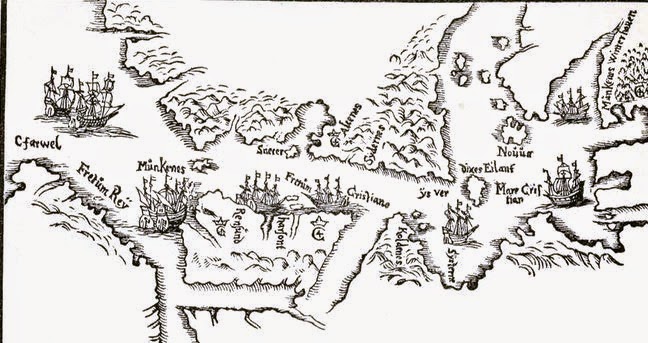
July 18, Eskimos
Munk lets himself be welcomed ashore when he sees natives on the beach. The tension was in the air. Henry Greene , who replaced Henry Hudson after the mutiny, was killed by an Eskimo arrow further into the strait in 1612. The Eskimos first hide behind rocks and have spears and bows ready when they approach Munk – although to his surprise, he is allowed to study the weapons to their delight. Munk hands over knives and other ironware. They only accept a mirror when he shows them how to use it. They are particularly curious about a dark-haired sailor to whom they feel a slight kinship. They managed to shoot some wild reindeer and the place was therefore named Rensund.
August, lost in the Hudson Strait
Westward in Hudson Strait, called Fretum Christian by Munk, the boats were forced to drift with the ice along Baffin Island. The dangerous journey was interrupted on August 1 with an anchorage where they hunted hares. The place was therefore named Haresund.
According to Munk, the navigators made the mistake of sailing straight south, believing that the ships had arrived in Hudson Bay. In fact, they sailed down into Ungava Bay ♦ and did not return to Hudson Strait until August 20. After about forty difficult miles of fog, tidal currents and ice, they arrived at Digges Islands ♦ and Hudson Bay (Munk’s names: The Sisters and Novum Mare Christian). Ahead of them was an inland sea three times the size of the Baltic Sea.
The frigate Unicorn only needs three days to cross Hudson Bay, on September 7 the ship rounds a peninsula where an anchorage is found at the mouth of a river. However, the Lamprell had gone astray in the storm. Wood is brought from the taiga forest for a fire. Luckily, the sailing yacht appears after a couple of days. (Munk’s Nova Dania can be found on Google Maps in the town of Churchill at the outlet of the Churchill River).
Where was the place for the wintering? Munk does not reveal exactly where, probably to return and salvage the Unicorn. Everything indicates that it was by the river later called Churchill River. Munk writes that the place was on the west side one Danish mile from the mouth, that is, eight kilometers. They sought protection from the drift ice in the river and ice that came from outside with the tide. Strong land uplift means that the sea level was three meters higher. Proximity to the Arctic forest was important. An educated guess is that Munk’s Nova Danica was here in the bay at the bottom left.

Arrived in Nova Danica
Many were sick, as the first signs of scurvy. Everyone therefore went out into the countryside to pick lingonberries and crowberries. Munk knows that they are good as medicine and with that diet the sick people recover, who now warm themselves by fires on the beach.
After a couple of days of snowstorm, they discover a polar bear feasting on the remains of a Beluga whale that he had caught. (The bears usually migrate here from their summer stay in the tundra to hunt seals out on the ice.) The bear is shot and cooked into a tasty meal.
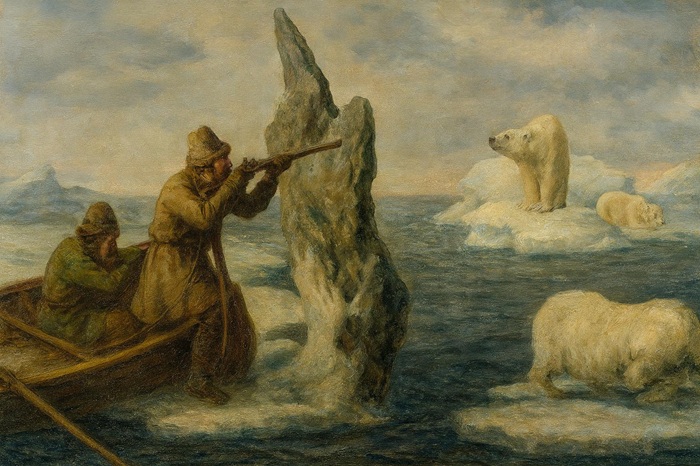
Scouts sent out do not find a good place to camp for the winter. The beaches are often flat marshlands exposed to wind and ice. The drift ice is bad for the planking when they look for a more sheltered place up the river. (The winter camp seems to have been located less than a mile from the mouth, just west of Churchill’s airfield).
Autumn on the hillside
September 25: At high tide, they manage to get the ships up on land, reasonably protected. The following days are spent building dikes around them with timber and mud. The ice is getting in and the Unicorn is leaking. They are forced to move the boat and start over.
October Everyone is accommodated on the Unicorn where they are given winter clothes. The cannons are stowed in the keel sprue to make more space on deck. There, about twenty men can warm themselves around each fire. Goods are stored on land and eventually two cabins with fireplaces are built. Munk brings gifts when he reconnoiters up the river, but the only traces of natives are summer settlements and graves. The crew is encouraged with wine and beer. Life is quite bearable if it weren’t for the drift ice. They are forced to brace the ships and improve the embankments.

Men carry game home and bury a dead one. A polar bear? is pushed “above” the ship
Hard frost so the river freezes over at the end of October. The men set traps and shoot foxes, hares, grouse and birds. The grouse taste good with the Spanish wine and the thawed beer on Midsummer’s Day, November 10. Even a black Eskimo dog that happens to pass by gets a bullet.
The tide causes the ice from the rivers to tower tens of meters. But the weather is mostly bearable. Although the frost at Lucia time means that the field cutter on Lamprenen, David Velske , cannot be buried immediately.
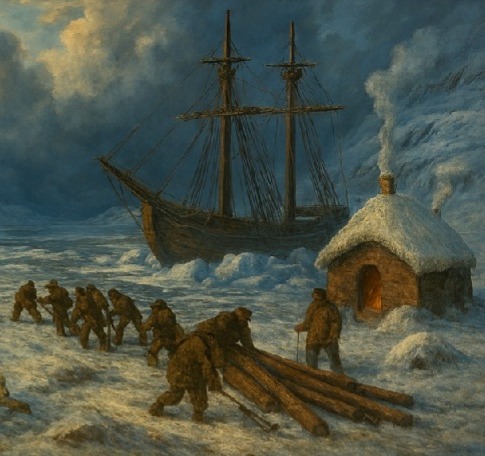
The men shoot a number of hares and grouse just in time for the Christmas party. The frost hits so the strong beer has to be thawed before it is consumed on Christmas Eve. The Christmas peace holds up despite the intoxication from the wine. After the Christmas Day high mass, the priest receives gifts, mostly white fox skins so that he can sew himself a coat. Everyone is in good health and can enjoy themselves with Christmas games.
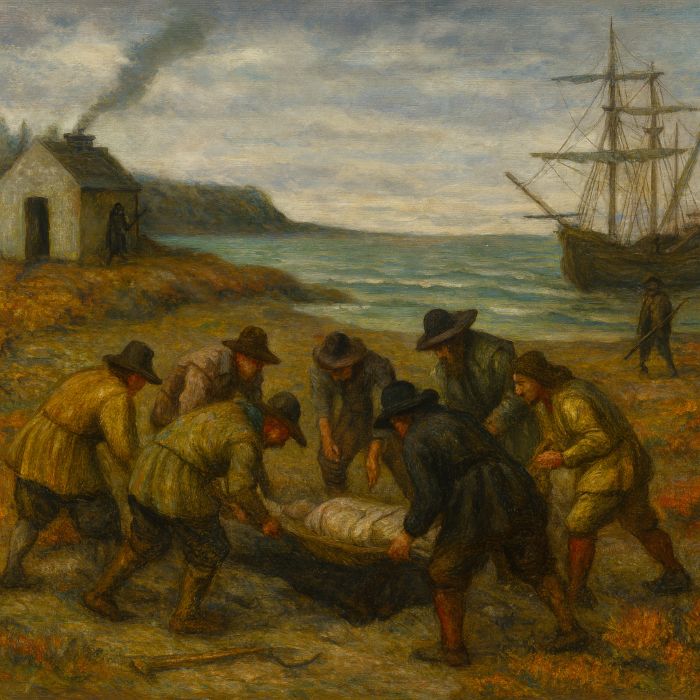
New Year with the Death Almanac
- New Year’s Day : north wind with a merciless frost. As a consolation, the crew receives wine as an extra allowance. The crowding and poor hygiene bring dysentery. Many lie in their bunks weak from scurvy. The first sailor dies on 8 January.
- On January 21, thirteen people are sick, among them the priest Rasmus Jensen and the field sergeant Casper Caspersen. Those who can go out to chop wood and trap grouse. The priest holds a mass from his sickbed over the dead navigator Brock. The funeral salute goes badly because the frost causes the cannon to explode and knock off the legs of a sailor.
- February 20: Twenty men are dead when Rasmus Jensen dies. It becomes more difficult to get firewood and cook food in the freezing cold. In better weather, partridges are caught and boiled into broth because those who are toothless from scurvy cannot chew the meat. More die during March but few are healthy enough to dig graves.
- March 25. Skipper Jan Olofsson dies. The snow has melted so much that Munk can pick last year’s lingonberries. Vitamin C is unknown, but he still knows that berries can relieve scurvy. He looks for suitable medicine in the pharmacy drawer but does not understand its use because both field cutters are dead.
- April 1. Jens’ nephew Erik Munk dies. The frost hits again and no chores are done because everyone is sick. More die but the funeral is postponed.
- Easter in mid-April . Jens the monk bathes in a wine barrel where he has poured the herbs of the field skerries into the warm water. Those who can bear it then wash themselves in the barrel one by one. Only Munk and three others are able to participate in Good Friday mass in the galley. On Easter Sunday, Anders Oroust and cooper Jens die. (Orust was written as Oroust until the 19th century).
- April/May . The mild weather causes the sick to go out into the sun on deck, although some faint from exhaustion. The wild geese appear. Those caught are boiled into broth, appreciated by the toothless who cannot eat the salted meat. Anders Marstrand and the boatswain’s boy Morten Marstrand die after a long time in bed. Munk does not write whether they came from Marstrand, but it is likely.
- May 12. Carpenter Jens Jörgensen and Sven Marstrand die. The nine who are still alive are so emaciated that they can barely bury the bodies. Ship’s manager Jens Hendichsen and the others who later die are left in their bunks.
- Whitsun, June 4. Only Jens Munk and two others are alive, sick and weak. The skin has turned black and the bones are not strong. The pain cuts like knives through the body. The stomachs are empty. There are certainly a lot of birds, but if you manage to shoot one, the toothless ones cannot get the meat. They cannot even crawl to the wine cellar. The stench of corpses stings the nose. The kitchen servant lies dead in Munk’s bed and three corpses are visible down in the hold. Munk is alone because the other two are on land and cannot bear to get on board. Jens Munk waits for death and writes a will.
- June 8. Munk can no longer stand the smell of corpses and drags himself out onto the deck where he sleeps wrapped in clothes from the dead. At dawn he sees his two comrades down on the beach – alive, not dead as he thought. They help him ashore where they warm themselves by a fire next to a bush. They crawl around and eat green shoots and roots. The ice drifts away so that at low tide they can set out nets where they catch six salmon trout. They boil the fish and freshly shot bird into a drinkable soup that slowly gives them new strength. From Lamprellen they fetch wine, which they haven’t drunk for a long time. But inside the boat the sailmaker dies so now there are only three of them.
- June, after Midsummer . Despite the Lamprenen being on land, the three men manage to get the yacht down to the lake. The sails are repaired and supplies are stowed from the Unicorn. Rotting corpses are dragged overboard.
- Sunday, July 16, is the height of summer. Mosquitoes are a plague on the marshes where the cloudberries are in full bloom. Finally, the three men can set sail. Beforehand, they have drilled holes to drain water from the Unicorn. The idea is probably to come back and retrieve the ship. This may explain why Munk does not give the names of his two companions nor the exact position of the wintering site.

The journey home
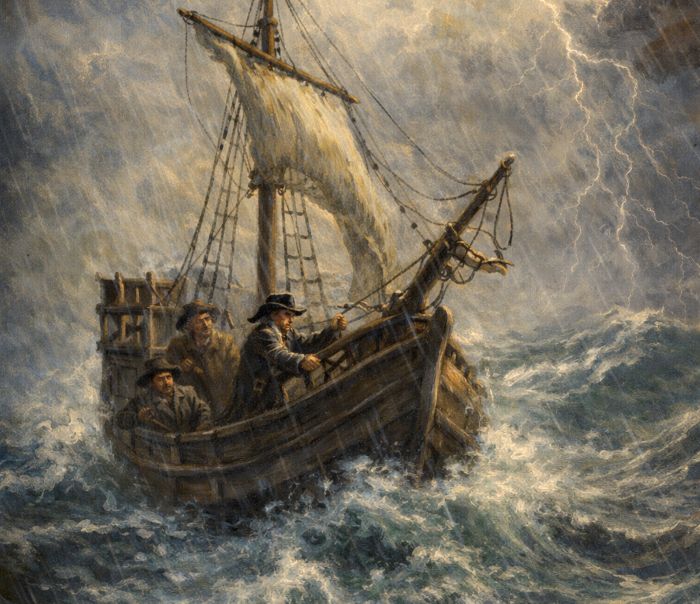
They drift with the ice that in a storm towers like a mountain. Sometimes they hook into an iceberg to slow down the drift. The rudder breaks. The ship’s boat breaks down but is found after a few days. The ship’s dog chased a polar bear and disappeared. It takes a month for the Lamprell to cross Hudson Bay, the last stretch of hard frost. They have to work hard in the storms to lower and hoist the sails.

Jens Munk’s journey. Map drawn in 1704
It takes the Lamprell a month to cross Hudson Bay, the last stretch of hard frost. In mid-August, the Digges Islands ♦ (Munk’s name: The Sisters) are sighted in the opening of Hudson Strait (Fretum Christian). Despite fog and ice, they force the strait in less than a week and set out on Fretum Davis towards Greenland. The Atlantic offers storms, fog and rain. They have to pump bilge, the rigging is damaged and a sail is torn. Exhausted, they sail south of Shetland ♦ on 13 September. The strong wind makes it impossible to get help from another ship, which they ask for.
The next day they see Orkney ♦ and after another day they sail into a fjord north of Bergen. The landing is difficult with only half an anchor. A farmer who is rowing past is forced at gunpoint to pull ropes towards land. Arrived after two months of travel, or rather after a month of actual sailing.
September 25th Lamprenen sails into Bergen harbor ♦ . Munk gets medicine from a doctor, But then the reception is not what he expected. The county lord imprisons him for three months. The reason is unclear. Perhaps for the skill of having destroyed ships and crews. Or because one of Munk’s sailors (On Lamprenen or earlier) killed a person and then escaped.
Christian IV intervenes so that Munk can return to Copenhagen just before Christmas – only to discover that his wife Catherine Adriansdatter has found another man. After the divorce, Munk remarries. He is frail so the new journey to Canada is delayed and then inhibited when Christian IV is drawn into the Thirty Years’ War in 1625. There, Munk acts as an admiral in battles off the German coast where his ship Lamprenen is lost. He also participates in campaigns in the Baltic Sea, with faltering health, and dies near Stralsund ♦ 1628.
Indians find useful items in the Unicorn and the stores in the houses. Although a number of them fly into the air when they accidentally set fire to the gunpowder.
The diary transforms Munk in 1624 into a travelogue Navigatio Septentrionalis that can be studied at the Royal Library on Slotsholmen in Copenhagen – the same place where Munk equipped his two ships.

Source tip:
- The Danish Arctic explorer Jens Munk. Johannes Knudsen. In Danish.
- DANISH ARCTIC EXPEDITIONS , 1605 TO l620. BOOK II.— EXPEDITION OF CAPTAIN JENS MUNK, 1619-1620. In English
- Jens Munk’s navigatio septentrionalis with introduction, notes and maps. In Danish.
/ Av Ingemar Lindmark